

Q1 26 Top Interviews: SAP, SaaS & the Agentic ERP
Q1 26 Top Popular Interviews
- Constellation Software: Public Sector Churn & Switching Costs — former Portfolio Manager of Trapeze US
- Roper Technologies: Leadership, AI Strategy Execution Challenges & Customer Retention Risks — former VP of Roper Technologies
- Amazon AWS and Anthropic: History of SageMaker & Bedrock AI — former Director of Amazon Web Services
- Mastercard & Visa: Services Revenue Strategy and Value-Added Services — former Senior Vice President of Mastercard
- Salesforce Agentforce: Data 360, Public Sector Agentic Workflows & CRM Positioning — former Regional Vice President of Salesforce
- Honeywell Aerospace: APU and Avionics Business Jet Aftermarket — former President of Honeywell Aerospace International
- TSMC vs. Intel, Samsung & GlobalFoundries: How Fabless Customers Choose Foundries — former Senior Vice President of Qualcomm
- IMCD, Azelis: Western vs Chinese Principals, Margin Mix and Switching Costs — former Product Manager of IMCD
- Broadcom & Google TPU: SerDes IP, Power Efficiency & Vertical Integration Strategy — former Senior Director of Broadcom
- Amazon DSP: Building Direct Publisher Relationships & SSP Disintermediation — former VP of Amazon Advertising
- Microsoft Dynamics vs Salesforce: CRM Market Share Dynamics & Competitive Positioning — former Senior Sales Leader, Microsoft
- Mastercard: Culture, Leadership & The Ajay Banga Transformation — former Senior Vice President of Mastercard
- ASML: EUV Technology Evolution & China's 2035 Manufacturing Timeline — former Senior Executive of ASML
- POOLCORP: Branch Density, Pricing Power & Regional Market Share — former Vice President of Pool Corporation
SAP, SaaS & Agentic ERP
Unsurprisingly, the impact of AI on software companies drove many of the most popular interviews in Q1. We explore why semantic knowledge may be the moat that determines who survives agentic disintermediation and how hyperscalers are positioned in the stack against incumbent ERPs like SAP.
Many of the interviews on Constellation Software explore the switching costs of vertical market ERPs:
That is a mainframe application that New York City Transit built in the 70s or 80s, and they have been running on that for a long time. They were looking to bid again; we won, then it was protested, and it is still in procurement as far as I know. - Former GM at Modaxo, Constellation Software
"If you think about a core banking business in Ireland that needs to deal with all of the local banking regulation, half of these banks and credit unions are running on physical green screen servers. The market itself is maybe a $100 million market maximum. There is no AI-native startup that's going to try and compete against that. - Former Director at Volaris, Constellation Software
Constellation owns over 1,500 subsidiaries each with various different jobs its solving for customers across multiple different workflows. And each workflow has a different exposure to agent orchestration. Constellation’s scale and diversity is a feature, not a bug, of the model but makes it difficult to research the company’s overall risk to AI.
Constellation seems more protected in regulated industries such as government, the public sector, healthcare, or utilities. We believe this could be ~50-60% of group revenue. As for the remainder, one former Constellation leader believes ~10% of Constellation’s total business portfolio is at real risk:
Not more than 10% of their portfolio. The retail industry will suffer slightly, but they have a strong portfolio of mining software solutions which is impossible to disrupt with AI. I believe that AI can help them to be much better and more efficient. Their development can speed up, and they can speed up customer service. But in terms of threatening them, I do not see how that is possible - Former Leader at Vela Software.
In a recent IP management reference check, we explore how Mark Miller, Constellation’s new CEO, has a different leadership style to Mark Leonard which could prove critical at this juncture:
Mark is a competitor on another level. This was another reason I was impressed when I met him to join the board. He does Tour de France cycling routes for his vacation. He also started marathons near his 50th birthday. Running 5k in 20 mins. If he does it, it’s hardcore. - Former Portfolio Leader at Trapeze, Constellation Software
Mark Miller wanted 10% organic growth out of his business units. Now with Mark at the helm, you will probably see him drive much higher organic growth across the portfolio. If your business wasn't doing well, Mark would put you in the penalty box… If you have an ugly baby, Mark will say you have an ugly baby and tell you to fix it.- Former Portfolio Leader at Harris Utilities
Even if Miller is more operationally focused than Leonard, he may have a deeper challenge to instill a culture of innovation across the group. Last year, we published research on how Constellation incentivises its portfolio leaders between organic and inorganic growth.
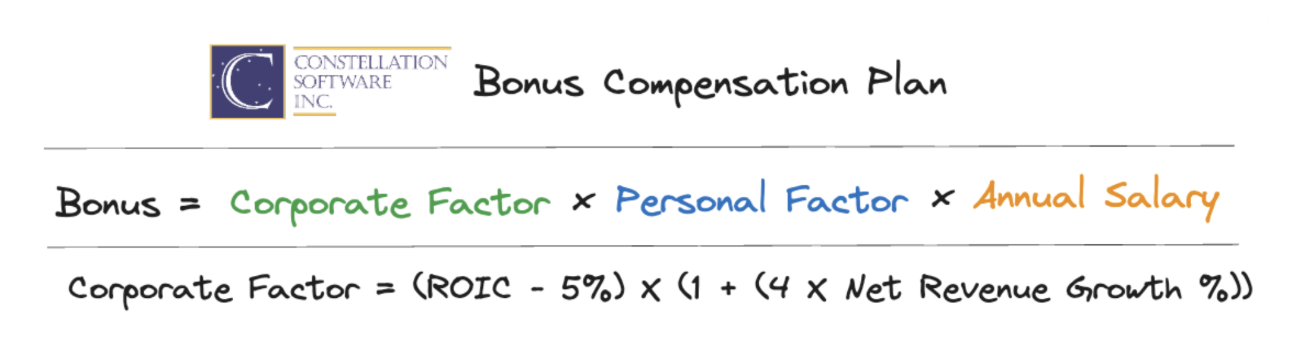
This was a quote from a former portfolio leader on where he spends time:
I was managing a £20 million portfolio with a 35% profit margin. That's about £7 million in profit. I had to deploy around £5 million of that annually. That's a lot of [organic] initiatives I need to fund to deploy my capital because initiatives come off your target. So, I'd have to decide to spend £5 million a year in R&D with no guaranteed return or I could buy or acquire one business. It’s easier to acquire companies. - Former Group Leader at Volaris
Beyond the cultural challenge, like all other SaaS companies, Constellation faces the larger risk of structural disintermediation by a new layer in the stack from companies such as Anthropic, OpenAI, and the hyperscalers. In our recent SAP primary research, a CIO of a Fortune 1000 company explains his thinking:
Multi-agent orchestration is going to be the most important thing in my mind… If I want the customer journey, I need to be able to orchestrate between companies, not just between technologies. - CIO at Large Fortune 1000 Company
Companies like SAP and CSU argue that the moat is their ‘semantic data and knowledge’. That the process know-how of a customer workflow is embedded in the ERP's system logic.
the semantic data model, the semantic process know-how. And that's, of course, something the ontology, the maps, the graphs, this is what we, of course, will actually offer on our platform, but we are going to protect that. - Christian Klein, CEO of SAP, Q1 26 Earnings
building products and features faster will not be what differentiates us long term. That capability will become widely available. It's going to be table stakes. What will matter is what our businesses have spent many years developing, deep vertical knowledge, a genuine understanding of customer workflows and processes, the data inside their solutions and the trusted relationships they've built. I believe AI will help us do all of this better. When I look at where this leads, the opportunity I find most interesting is what I described as knowledge networks, connecting our domain expertise, customer process knowledge and data assets in ways AI now makes possible. - Mark Miller, CEO of Constellation Software, Q1 2026
But what does ‘semantic knowledge’ actually mean? And why can’t Anthropic or Google partner with customers to build this?
Put simply, semantic knowledge is the codified approval logic, master data, and process customisation built into a customer's SAP instance over decades. It's also only writable within SAP, and almost useless to any agent that can't sit on top of it. How SAP and other ERPs build agents atop this semantic knowledge, and how it allows other third-party systems to integrate with its semantic knowledge will determine the risk of disintermediation.
To frame the potential risk to SAP, we can imagine two simple workflows:
- A corporate financial controller paying an invoice
- A CFO querying why margins have declined this quarter
Workflow one could look like this:
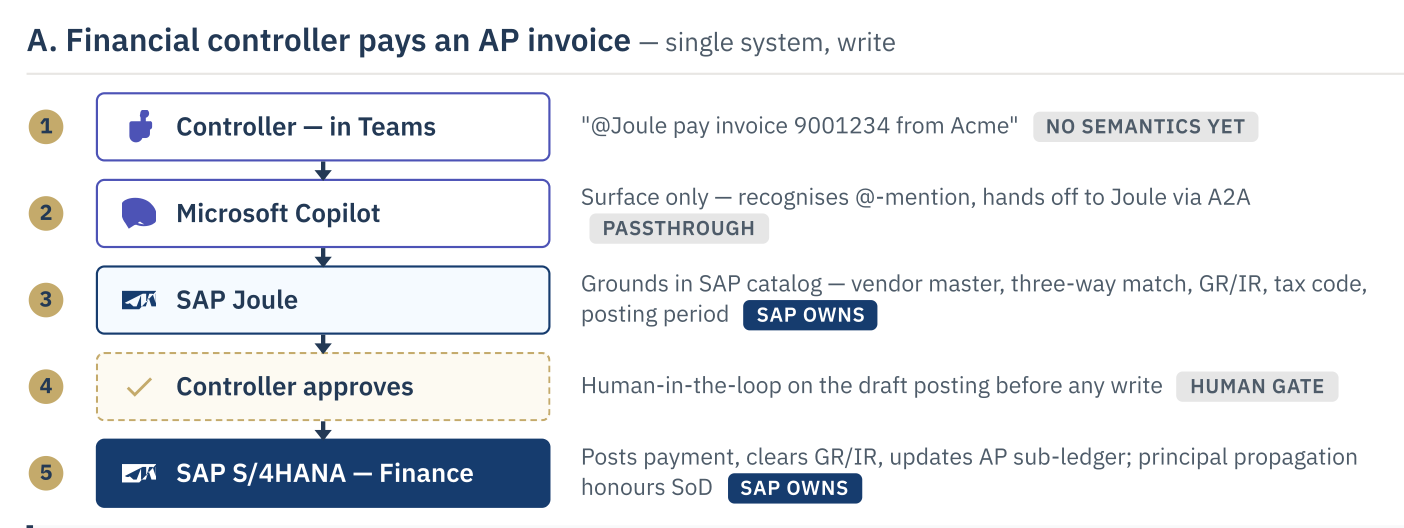
SAP remains critical to propagate, write, and record the transaction. It remains the source of truth that the invoice is paid. The semantic data sits in step 3 and 5; it lies within the procedure and authority to execute closing the invoice. This typically includes customised processes, approval hierarchies, and other master data built over decades into SAP. It’s only writable in SAP and is now baked into Joule, SAP’s agent that orchestrates the workflow.
To reproduce this agentic workflow, an external agent would need to reconstruct years of semantic data and workflow customisation. This is possible given the customer is the owner of its data. It could grant Anthropic, Google, or Microsoft full write-access to rebuild all semantic knowledge. For large enterprises, this includes thousands of customised tables, custom code, new authorisations, etc. It's possible, but seems unlikely:
It'll take years for us to migrate. This is one big business model that SAP has. We're kind of a captive audience. It'll take five years to migrate, find another alternative, and so on.- CIO at Large Fortune 1000 Company
Workflow 2 seems more where Microsoft, Google, or Anthropic have a right to win. The CFO requires multi-agent orchestration across SAP, Workday, CRM, etc to grasp a full picture of revenue, COGS, operating costs, and overall quarterly performance. SAP is one part of the context required to resolve the query. The orchestration layer that best integrates across all software vendors, email, Teams / Slack, etc seems positioned to win. This remains the case for many other reporting, analytical, or strategic queries for a business.
A recent rebranding of Google’s Knowledge Catalog highlights how hyperscalers are positioned for such agentic ERP workflows. The Knowledge Catalog is the context engine to help agents execute complex tasks more effectively. It aggregates context across Google and external platforms, semantic models, and third-party catalogs, unifying them into a source of truth for customers. The catalog integrates with Gemini Enterprise Agent Platform to run full agentic workflows.
Knowledge Catalog uses Google Cloud’s Lakehouse to connect systems with a broader context and has full visibility to SaaS solutions. For example, a customer’s SAP data is automatically mapped to the Knowledge Catalog with read-only access. Note, read-only doesn't mean full access to the rules underlying the actions. Writing and updating records remains in SAP. Knowledge Catalog is effectively a governed semantic layer that can combine unstructured data from email, chat, etc.
While Google’s catalog is not necessarily unique, Microsoft Fabric, AWS, Snowflake, and Databricks all have similar offerings, it provides a perspective into the fine line companies like SAP must straddle between protecting its position in the stack and providing customers the ability to query across all software vendors within Excel, Teams, Gemini, etc.
In short, we find it helpful to analyse software by workflow to understand AI defensibility. Workflow 1's semantic knowledge is about following rules: who can approve an invoice, in what order, and against which company policies. These rules live inside SAP, written into each customer's setup over many years. Workflow 2 is about understanding a broader context and dataset: what "margin" means, where revenue lives, where costs live, what the fiscal year looks like. This information sits across SAP, Workday, Salesforce, email, and chat. No single system owns it.
This leads to two questions worth asking:
What share of the value and work SAP that users actually complete is workflow 1 versus workflow 2?
How much of SAP's pricing power depends on workflow 1 and does that share hold, grow, or decline as more work moves into multi-system orchestration?
These are some of the questions we’re exploring this quarter. And given this comment by a former SAP executive, we will be watching SAP’s Sapphire event next month closely:
Externally, what I'm seeing is more and more customers, even though they're moving to the cloud, are starting to ask the difficult question, the nasty question, as to what kind of AI benefits can we get from you. You talk about Joule. Joule is your only answer to AI, but it doesn't work in a complex environment. It hangs, it crashes. All the promises around business AI have not been delivered to the client. - Former SVP at SAP
These interviews can be read with other recent work on agentic workflows and AI risk to SaaS:
Related Content

© 2026 In Practise. All rights reserved. This material is for informational purposes only and should not be considered as investment advice.