

Howmet Single Crystal Blades, AMZN Logistics, Synopsys & Cadence AI Risk
Here is a selection of interviews published last week. Visit our platform for all research published.
Published Last Week
There is a niche oligopoly that is a potential bottleneck for both aerospace engine deliveries and the AI data centre buildout: single crystal turbine blades.
The primary single crystal casting is done by three companies... PCC and Howmet probably own 80% of the market, maybe even higher for single crystal. - Former Airfoils Unit Manager at Precision Castparts
Single crystal airfoils are an engineering marvel. A turbine blade in the hot section of a commercial aero engine runs at temperatures exceeding 1,650 degrees Celsius, hotter than the metal's own melting point. GE Vernova's HA Class gas turbines powering AI data centres operate at similar temperatures of ~1,500 degrees Celsius.
Normal cast metal is made up of millions of random grain crystals packed together. At the intersection of these grains is where issues can arise. Heat and stress can cause cracking and malfunction along grain boundaries. In the 1960s, to make the blades more robust in such high temperatures, Pratt and Whitney designed the single crystal blade. The entire blade is made from one grain. By removing the grain boundaries, it can operate beyond its melting point. The far right blade is single crystal; middle is directionally solidified, and far left is more typical casting of multiple grains.
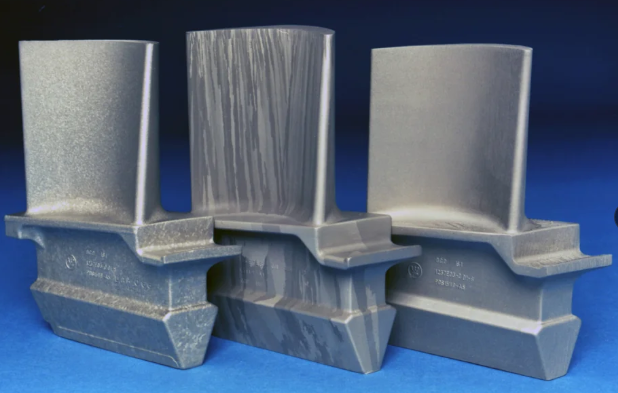
Casting a single crystal blade is very difficult. Not only do the airfoils need to be cast from one grain, they also need ceramic coatings and cooling passages to prevent it melting in operation. Current backlogs are ~18 months. And the complexity leads to a 20-30% scrap rate even for the leading players with decades of experience.
The biggest yield loss occurs at the grain structure stage. A machine called Laue inspects the grain structure of the casting, checking if the grain boundaries and angles are within specification... it is often the area with the highest yield loss.- Former Director at Howmet Aerospace Inc
The human expertise capable of casting single crystal blades is limited globally:
A single crystal part has to go through grain reading to examine grain boundaries, and it can take a year to become a certified grain reader. - Howmet, PCC & the Single Crystal Blade Bottleneck
While the engine OEM may own the engineering design of the blade, they don't manufacture the part. This outsources the 'process IP' to the three casting players. Howmet dominates in the most complex stage 1 blades:
Howmet is best in class on every stage one... because they design and build their own ceramic cores, which give you consistent wall thickness... they're really the primary stage one supplier, which is the blade that sees the most heat and the most harsh environment. - Former Vice President of Supply Chain Strategy, General Electric
This unique process IP translates into pricing power for Howmet and PCC:
Both PCC and Howmet have been expanding, which is why they're able to command higher prices. They use capacity as negotiating leverage. In order to guarantee capacity and delivery in a contract, they ask for higher prices, and they're getting them. - Former Director at Howmet Aerospace Inc
Due to the backlog and pricing power of blade suppliers, both Safran and SpaceX are considering manufacturing single crystal airfoils.
This is why we've decided to invest in our own casting facility, turbine blade casting facility of our own. We have decided to invest, and we are investing in forging. You know, we are the only—I'm not sure that whether you know that, but we are the only engine manufacturer in the world having forging capacity internally. We are the only one. And we have decided to invest more in forging as well. So we basically have a strategy to, let's say, unlock the situation and to, how could I say, decrease our dependency or exposure to some big guys that could potentially have a Malthusian strategy. - Olivier Andriès, CEO, Safran FY2025 call, 13 Feb 2026
"It's the vanes and blades in the turbines that are the limiting factor because it's a very specialized process to cast the blades and vanes in the turbines, assuming you're using gas power... In order to bring enough power online, I think SpaceX and Tesla will probably have to make the turbine blades, the vanes and blades, internally. - Elon Musk, Cheeky Pint Podcast
This interview walks through the supply chain bottlenecks in airfoils, why they are so difficult to manufacture, pricing, and engine OEM / casting relationships. You can read this alongside various other interviews on the topic:
Last month, Amazon announced Amazon Supply Chain Services (ASCS), opening its freight, distribution, fulfilment, and parcel shipping capabilities to businesses of all types, not only Amazon sellers. GXO was down ~18% on the day:
Amazon is trying to become an all-purpose third-party logistics company, like DHL. They want to be able to provide soup-to-nuts capability, whether that be freight forwarding or freight brokerage, eliminate the middleman, the last-mile delivery of the package, the LTL freight that can move from A to B domestically across the country, and even an FTL backhaul load that they need to fill a particular lane. - Amazon & the Threat to Freight Forwarding & 3PL Services
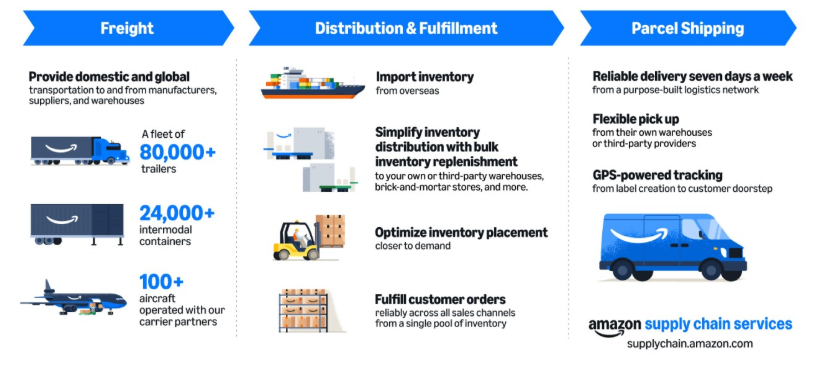
We’ve previously explored how Amazon has built and organised its fulfilment network. Since COVID, it has built an outbound delivery network to rival Fedex with ~70% coverage of all US zip codes.
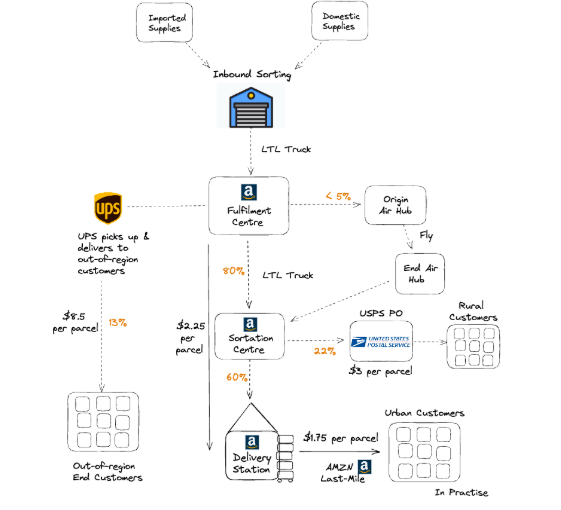
Amazon is also moving deeper into the supply chain. It is building inbound sorting stations in China. Instead of Chinese 3P sellers shipping merchandise to a US sortation centre, Amazon is taking ownership of inventory in China and organizing ocean freight. It even manufactures its own ocean containers:
Amazon manufactures ocean containers. They have over 10,000 of them. Now they can use their own duty and brokerage and customs capabilities - Amazon & the Threat to Freight Forwarding & 3PL Services
Owning inbound from China to the US enables it to route inventory more effectively into FTL vs LTL. Saving unit costs.
That's the purpose of these transloading buildings, which you can call consolidation facilities, because you might have 50 vendors arriving on Monday. You unload everything and organize it all by destination, and then once the truck is full, you close the door and send it off. Now it's FTLing down the highway. Amazon didn't have that piece of the puzzle organized two years ago. - Amazon & the Threat to Freight Forwarding & 3PL Services
Amazon is also building out LTL facilities. This interview explores how Amazon may threaten LTL incumbents like ODFL:
If you're in Los Angeles and you're a vendor and you have to ship seven pallets to Pennsylvania, today you're doing that via a third-party LTL carrier. Tomorrow Amazon will say, "We have an LTL consolidation building in the Inland Empire. Send your seven pallets there. We'll consolidate that with everybody else's stuff and send an FTL down the road with multi-vendor products on that truck rather than you going to Old Dominion to use that freight. - Amazon & the Threat to Freight Forwarding & 3PL Services
This interview walks through how Amazon has built its fulfilment network, the changes since COVID, and how it may threaten 3P logistics companies.
We’ve recently published interviews on the risk to Cadence and Synopsys of large customers such as NVIDIA and Intel building internal tooling. Customers have built abstraction layers on Cadence and Synopsys:
A lot of them have developed code inside the companies where the engineers don't know which tools they are running. They start a job and based on what is available, what licenses are there... the system inside the company decides which one to use. - Former Chief Marketing Officer & Senior VP Enterprise Marketing, Synopsys
NVIDIA has built its own RTL-generation tool.
NVIDIA, for example, built a tool three years ago to generate RTL based on LLMs... Synopsys and Cadence will always claim... you can write your own tools, but if you want to push it to our tools, we know how it is going to get treated. - Former Chief Marketing Officer & Senior VP Enterprise Marketing, Synopsys
And a former Intel executive believes its internal tooling can reduce the pricing power of Cadence / Synopsys AI add-ons:
It is possible that Intel's own proprietary solution of AI-assisted design can replace this EDA tool feature of AI. So the EDA companies might lose business in terms of the AI features in the future. - Former Senior Director, IP Engineering (DDR & HBM Memory) at Intel
But there are also many reasons why Cadence and Synopsys’ data and product offering is hard to replace. These interviews go into detail on switching costs and recent risks from customer internal tooling:
Related Content

© 2026 In Practise. All rights reserved. This material is for informational purposes only and should not be considered as investment advice.