

Accenture and SI Economics & Markel Insurance CEO References
Given the growth in interviews we’re publishing and to save this email becoming one long list list, we’re only listing a selection of ~25 interviews per week. If you wish us to publish all interviews, please reach out and we will revert back to the old format.
Published Last Week
Accenture & System Integrators for an Agentic Enterprise
Accenture trades at ~12x NTM FCF. In the last month, we’ve been studying system integrators within the Workday ecosystem and how AI is disrupting SI economics.
A typical enterprise SaaS customer spends 5-10x the original software license fee to design, specify, implement and run the software. This includes implementation costs, managed services, and in-house SaaS-certified employees. A Senior Partner at Accenture, one of Workdays’ largest partners, shares more:
The system integrator work is often 4 to 5 times more expensive than the licenses. For $5 million, you have a core HCM implementation for an international company with up to 30,000 employees. If you go to 100,000 employees with a more complex, extended implementation, you end up in the $10 to $15 million range. For companies like Stellantis or Richemont, which are very decentralized, complex organizations with complex governance, you can hit $20 to $25 million. - Workday: Implementation Costs & Accenture Agent Deployment
A typical enterprise SaaS project for integrators requires upfront design, deployment, and managed services throughout the life of the contract. Implementation is where the perceived AI risk lies. AI agents can migrate data and deploy software more efficiently than an outsourced team of developers. Customers and software vendors continue to demand significant increases in implementation efficiency:
10 to 12 years ago, it was an open checkbook to deliver this sort of thing… Nowadays, the economics are much tougher. There's an expectation that stuff is delivered much more cheaply, that it's delivered on a fixed price basis. Gone are the days where customers are happy to pay you thousands of pounds a day to just sit on customer side without any output-based billing. Everything now is built on milestones and built on output. - Current Partner at HR Path (mid-market Workday SI)
SaaS vendors are also building agents themselves to increase efficiency for mid-market customers. This will continue to pressure SI implementation margins.
Deployment Agent is actually now applying AI to automate that entire process. It's the next logical step, if you think about it, from improving that method further to make it AI automated. The mission is "the $0 deployment of Workday in a month." - Workday CTO, Q1 27
The pricing model of implementation is shifting from time and materials to outcome-based measures:
Take a company like Accenture. We have close to 300,000 people in India. An integral part of our go-to-market and business model is that we capture requirements and do design work onshore with clients, and then we send it to India for implementation. There are bodies doing the implementation work. That part in India that we measured as headcount until now, we are switching as of September to measure as productivity… If we are time and materials, we expose that completely to our clients and give all the benefits of that investment to them. It used to be about 50/50 - half fixed price, half time and materials. Today we're certainly 80% fixed price implementations - Workday & Accenture: Agentic AI Impact on System Integration
On the other hand, Accenture is seeing efficiencies deploying internal agents for implementation:
We have eight Agentic Agents today that help in the implementation of Workday. That has an impact on the productivity and the number of hours we spend on an implementation. Today the minimal bar we put in place is 10%. - Workday & Accenture: Agentic AI Impact on System Integration
SIs focused solely more on testing, integrations, and implementation face structural challenges. An interesting rebuttal is that probabilistic AI models may create more maintenance work than deterministic systems:
the effort needed to maintain… a probabilistic technology [is more than] deterministic technology. So we have actually more work to do in maintaining than before. So I see this as a significant tailwind to our BPO business." - Ravi Kumar, Cognizant CEO (Q4'25)
While implementation is challenged, the discovery and design phase of an enterprise software deployment project remains critical and more nuanced.
The design, the understanding of what the organization actually wants, is for two reasons. One is because often it isn't written down, so they don't actually know in all cases. You have to ask them, probe and say, well, how does this work? And what about that scenario? And they say, oh, actually we don't know, let me go and check. So the design is by far the longest part of that. And then the configuration itself is not that complex, assuming they give you the right requirements, which they often won't because they do this once every 10 years, maybe. It's not every day. - Current Partner at HR Path (mid-market Workday SI
Around 60% of a project’s typical implementation cost is within the design stage.
Probably 50% [of time to complete a project] sits in your design phase and then 50% sits in what comes after, but the second 50% bucket is considerably cheaper than the first one because of the rates. You're probably looking at 60/40 [split in cost between design and implementation]. Yes, because it's typically done with people onshore who are expensive - Workday & Accenture: Agentic AI Impact on System Integration
The system integrator value-add seems to have been pushed deeper into both ends of the deployment process: at the front-end upfront design and back-end managed services end.
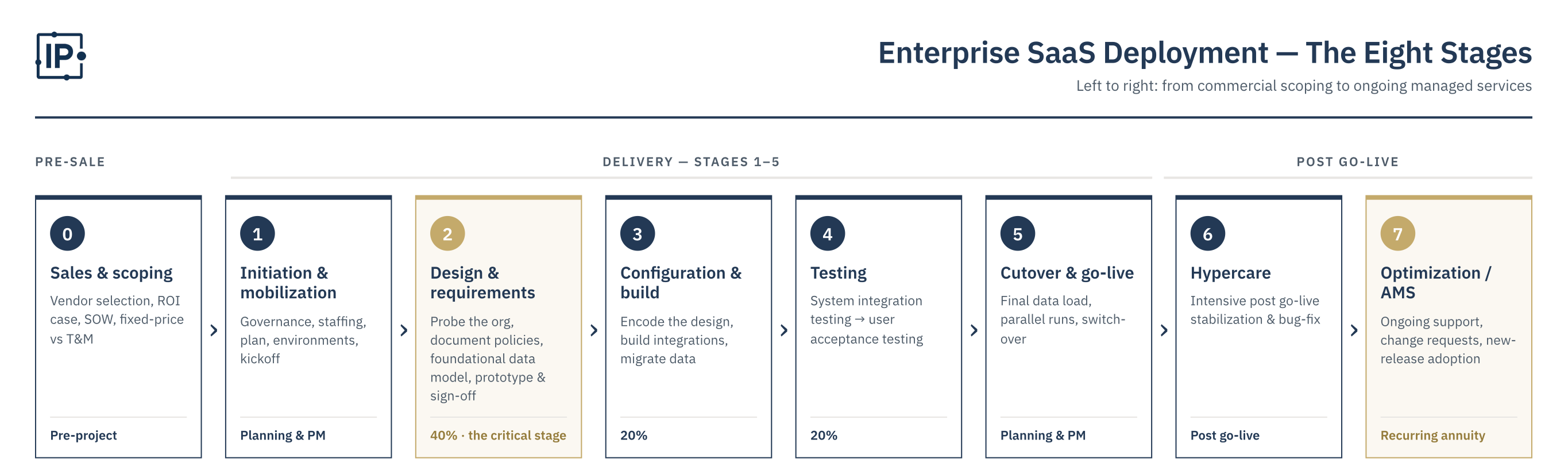
OpenAI and Anthropic have launched ‘deployment companies’ to compete with ACN at both ends of the spectrum. Interestingly, Accenture is a Frontier partner to OpenAI but didn’t invest into OAIs Deployment Co. We plan on studying ACN positioning in the agentic stack compared to new entrants in more detail this year.
You can read more about this topic in these interviews:
In December 2024, Jana Partners suggested a restructuring of Markel Group to unlock value. This led to a strategic review by Markel’s board. In March 2025, Simon Wilson, the Former President of Markel International, was promoted to CEO of Markel Insurance and tasked with improving underlying performance in the US.
In the last year, Wilson has reorganised the US insurance group to focus on smaller business units. He has cut unprofitable lines and aimed to simplify the structure:
Today, we have 14 distinct business units across Markel Insurance, each with a single leader and a discrete P&L. These business units are grouped under our three ongoing divisions… Each P&L leader is responsible for selecting their teams, producing their strategy, agreeing to their business plan, designing their product set, and overseeing their expenses. Their total compensation is aligned to the long-term profitability. A second key structural change was shifting most resources from the corporate center to the business units themselves…" - Simon Wilson, CEO Markel Insurance, Q1 2026 call
We spent hours collecting references from Simon's former colleagues, bosses, and direct reports, exploring his character, personality, track record, and leadership style. Our research also shares insights into the culture of US wholesale insurance, the perceived internal politics, and where Simon may face challenges structurally changing US insurance performance.
The perceived historical challenges in the US insurance business partly stemmed from a cultural focus on production volume over underwriting results:
I think because too many people in leadership positions at Markel are focused on being business development type people and marketing people. The most important thing is the broker relationship. If you have a pendulum, the most important skill is business development, establishing relationships with the brokers. There is not the same kind of emphasis on underwriting, operational effectiveness or leveraging technology - Former Senior Executive at Markel Group
Simon aims to change this. But the reporting structure of the insurance business still seems confusing within the underwriting and production matrix. Our research dives into the US Wholesale and Specialty division in more detail.
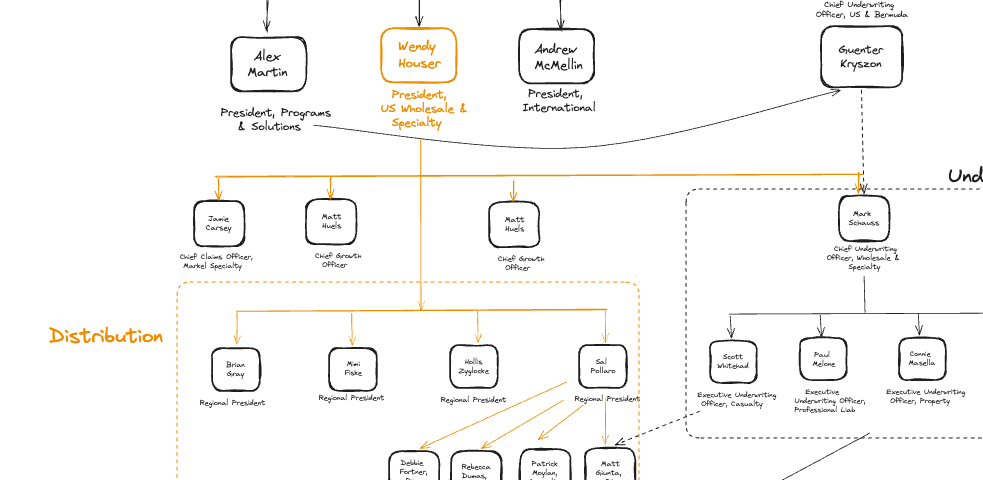
I think in certain parts of the organization it was easier to separate them out and it would be clearer what was going on. The stuff reporting into Alex, each of those were already defined business units, which makes it much easier. Wendy's org is messy. You also have the issue of wholesale versus retail. She has a lot of retail in that org. They are calling it specialty, but it is retail, so there was always a lot of channel conflict there. I don't know how they are making that work. I think that is what they are trying to focus on. I am not saying they haven't by putting in these regional product line leaders, but I get the sense that it is still a bit messy. - Former Global Executive Underwriter at Markel
Last month, Jana Partners again suggested the company divests Ventures and repurchases shares to ‘liberate the company from persistent undervaluation’. While we can understand shareholder impatience, this seems short-term minded. Markel may not have the best combined ratio or GWP growth rate in US E&S insurance, but it has earned an average 96% CR whilst growing earned premiums ~5,000x over the last 40 years.
In its holdco structure, the ability to redeploy this underwriting profit into private or public companies seems a more durable, long-term risk-adjusted return than carving out Ventures. Splitting up the group would reduce the durability of its earnings power. It would become more of a traditional insurance company. And that isn’t what Markel is. After all, the parent listed entity is called Markel Group, not Markel Insurance.
This reference check can be read alongside our prior work on Markel:
We now have the following reference checks completed that are available standalone or as a bundle. We plan to scale this product to hundreds of high-quality reference check interviews:
Related Content

© 2026 In Practise. All rights reserved. This material is for informational purposes only and should not be considered as investment advice.