

NVIDIA vs Google's TPU, Netflix Culture, Intel, GE & PMAs
Here is a selection of interviews published last week. Visit our platform for all research published.
Published Last Week
TPU, Trainium, & NVIDIA Vera Rubin
A Former Technical Program Manager of AI at Google believes Vera Rubin will only extend NVIDIA’s edge:
NVIDIA decided to go from massively parallel GPUs using x86 and networking, to a more robust topology with a larger NVLink scale-out domain, but also having these larger dense NVLink domains, also moving from x86 to ARM and then having the ARM co-embedded with the GPU. When the GB200s came out, I was surprised that NVIDIA was making an HPC ML accelerator platform. They went from parallelizing their GPUs as much as they could, to making a massive computer that has co-optimized and co-placed CPU and GPU capabilities. Before the GB200, it was technically the H200. They were trying to do it with the Hopper series, but it didn't work out as well as the Grace. GB200 is the first one. GB300 is a slight iteration on top of that. Vera Rubin is the real next-gen thing. NVIDIA's desire to build that class of computer is amazing, and I don't think people even fully understand the capabilities of what that machine can do because most people are focused on optimizing LLM throughput. The GB200 systems can fundamentally do more for scientific research than probably any other system that exists. - Former Technical Program Manager of AI at Google
And how this may be leading Google and Amazon in a race to the bottom:
I do think that TPU is compelling for inference, but you also run that issue of, do I need to invest the time to port my stuff to TPU to get it running on inference? I think they are trying as best as they can to make that more compelling. If I were to look at the two systems side by side, I think when it comes to inference, Google is maybe trying to be cheaper than NVIDIA, then AWS is trying to be even cheaper than Google. Everybody is on a race to the bottom - Former Technical Program Manager of AI at Google
The interview goes on to explore how customers choose between TPU, Trainium and GPUs, total cost of ownership, and why Google’s capabilities of large TPU clusters isn’t as relevant as the market may think. This can also be read alongside the following:
Netflix Culture
Since 2023, Netflix’s total hours viewed has increased by 4% since 2023 despite total members being ~25% higher. Original hours consumed are flat too:
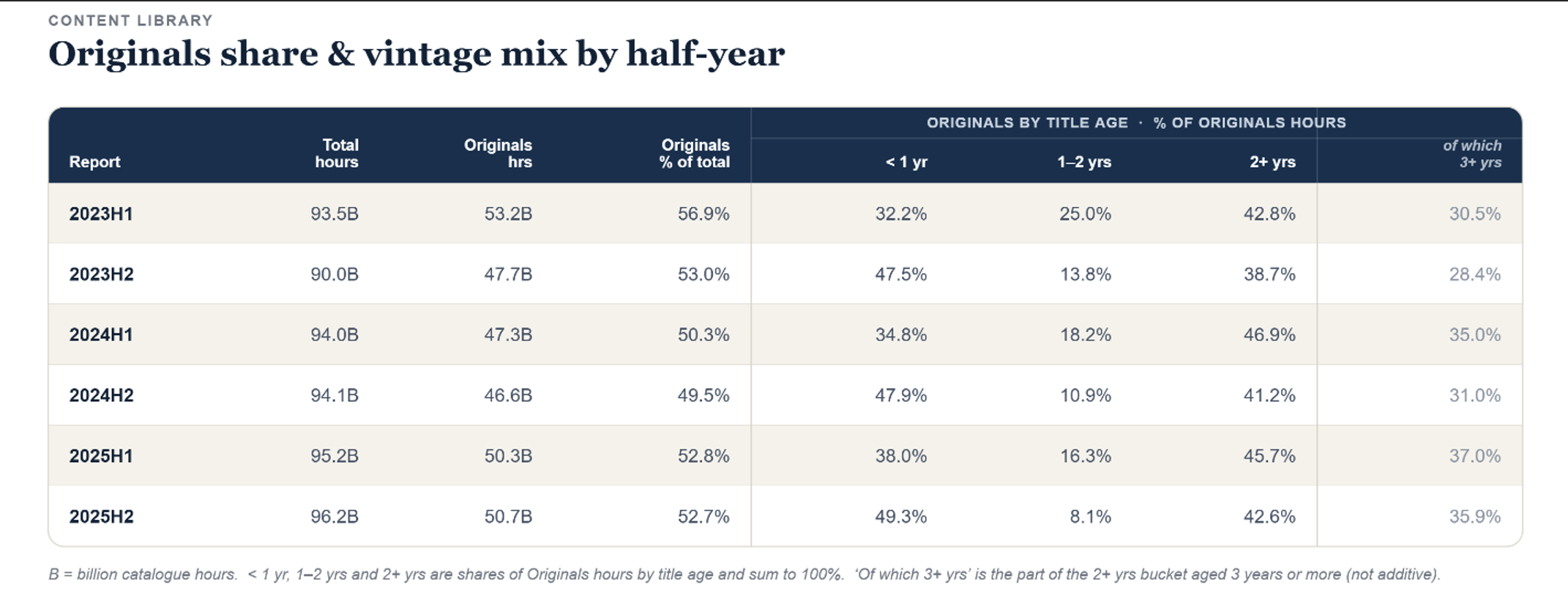
Over the past months, we have conducted several hours of interviews with former colleagues and direct reports of Bela Bajaria, Netflix’s Chief Content Officer. Our aim was to study how Netflix produces content, decision making, and capital allocation framework.
One interesting takeaway was the tension between Netflix's two distinct cultures: old school Hollywood and techies. This tension seems real.
Every now and then we would have these meetings where the product team from Los Gatos would come in, and it was the funniest culture clash because they are still old school Netflix—really bluntly disagreeing in meetings. The Hollywood culture, not just at Netflix but everywhere, is so passive aggressive, whispering in the hallway after, with no one speaking directly - Former Director of Original Film at Netflix
And it also shows up in how the company allocates capital. Ted and Greg seem to have different philosophies to capital allocation. This may create a healthy tension:
The inside scoop on the Warner Brothers Discovery acquisition is that Ted was pushing for it really hard and Greg was saying it is a bad idea. In terms of Wall Street perception, we looked like the most disciplined company in history. The price moved up a dollar and they walked away thinking, "Wow, they didn't let their egos get in the way." But I know people who were on the Warner integration team at Netflix, and they know these discussions. Basically, there wasn't 100% alignment on whether to do this deal. But at Netflix, there's this culture of "disagree and commit." If we decide this is what we're going to do, we're all going to commit to it. But there's this continuing tension, and you can think of the figureheads of that as Greg and Ted. Bela supported Ted, and people in the product organization supported Greg. Long story short, I think that $1 price increase on the deal was basically an excuse to get out of it. I don't think it was a case of "now our model says it doesn't make sense." It was more like, "This might have been a mistake, and this lets us not only get out of it but look disciplined when we do" - Former Director of Original Film at Netflix
This tension also shows up in Netflix's content-creation philosophy, which appears to have become more centralized in recent years. The original decentralized greenlight model has given way to more top-down approvals, which may be constraining risk-taking and the discovery of unexpected hits.
A lot of the hits that Netflix had probably wouldn't even be discussed in meetings. Most of the hits that were there were not the big swings of these big auspices coming in to make shows. It was the small stuff that nobody expected to be a hit. Stranger Things was a $5 million an and it became a giant hit. That show might not have been made or greenlit in a new era I think Bela has solid taste. She absolutely has good instincts, but her weakness is she's not a risk taker. You're not going to get the Breaking Bads and the Orange Is the New Blacks because those offbeat subject matters, maybe quirky cast leads, things like that are probably not going to get their chance. - Former Director of Original Drama Series
This reference check can be read alongside our other work on Netflix:
Nvidia, Intel & the GPU-to-CPU Ratio in Agentic AI Infrastructure
A former Global Director of Intel AI Products and Strategy explores how agentic AI adoption is driving greater demand for CPUs:
The GPU layer is providing real value while also opening the door to greater demand for CPU workloads. That value in turn drives demand for more GPUs, because GPUs are so valuable in unleashing the power of CPUs - Former Global Director of Intel AI Products and Strategy, Intel Corporation
The operational work agents perform such as querying ERPs is deterministic and must be accurate. This runs on CPUs:
We're now talking about holding tools, building applications, choosing which models to use, and evaluating results before delivering them. There are many operational loops around the data in ERP systems, including vector database queries, policy lookups, security, and API integrations. Agents' access to data is a significant concern. We don't want agents to have access to all data or the ability to delete it. This results in a great deal of serial workflows on the operational side. All of that will run on CPUs. - - Former Global Director of Intel AI Products and Strategy, Intel Corporation
Over time, this could lead to 2-4 CPUs per GPU:
Going out a few years, Arm CPUs will start getting deployed and dedicated AI factories for agents will be built, rather than just retrofitting existing environments. Once new infrastructure is optimized for agentic workloads, I see no reason why it wouldn't be two to four CPUs for every GPU. GPUs are powerful and getting more so, handling a lot of concurrency in terms of requests, and spinning out a lot of demand for agentic workflows. - - Former Global Director of Intel AI Products and Strategy, Intel Corporation
Read this alongside:
- Nvidia, Intel & the GPU-to-CPU Ratio in Agentic AI Infrastructure — Former Global Director of Intel AI Products and Strategy, Intel Corporation
- The History of x86, ARM, & Amazon's Graviton Processor — Former SRE Leader at Google
- Amazon Web Services: EC2 Graviton Strategy — Former Senior Manager at Amazon Web Services
- AWS re:Invent: Trainium, Graviton 5 & Bedrock
- Qualcomm, Apple & HPC (2025-12-28) — really about foundry sourcing, not server/client CPUs.
GE Aerospace, LLPs, and PMAs
For years we’ve heard the PMA bear case for GE and TransDigm. Given aftermarket price increases from both companies, investors worry that companies will produce a competing PMA part at a 30-40% discount to the OEM. And airlines love discounts on maintenance.
Yet, the PMA share of the global materials market by value has remained constrained to 1-3% for decades. And this is even while the number of PMAs approved by the FAA has grown. Before 1990, ~2,000 parts were approved. Today, the FAA approves closer to ~30,000 parts per year.
There is no clear defining PMA market size given the complexity; for eg, OEMs such as TransDigm also own T&C PMAs to protect its own OEM part or attack competing products. In 2015, Oliver Wyman estimated PMA share as ~1-3% broken down as follows:
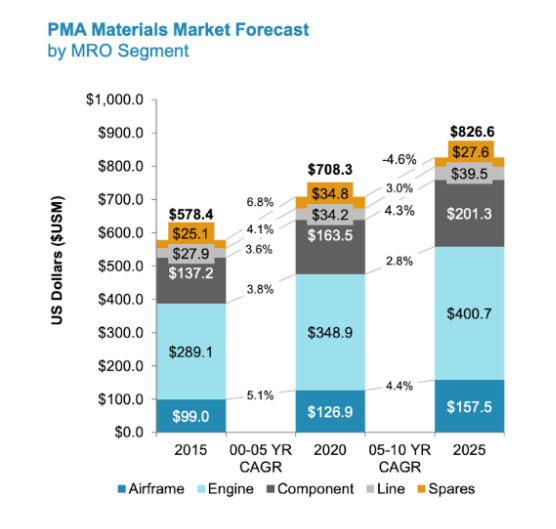
Different product segments have different PMA risks. All else equal, line replaceable units within the cabin are more at risk than engine components. Switching out an engine airfoil in the hot section is very different to switching out galley insert. It's riskier for airlines. And the engine lessors and OEMs have tactics to make it even more difficult to switch in PMAs:
Lessors are 50% of the market and strictly against PMAs… OEMs capture a market share of 55% to 60%… If you are a PMA supplier investing heavily in design, but 60% of the market is controlled by OEMs, you won't succeed in penetrating these engines. Another 50% of the remainder are likely leased engines, leaving only 20% of the market for PMA development. At any time, OEMs can release a part or reduce prices, leaving PMA suppliers with no chance. - Former CEO of MTU Maintenance, MTU Aero Engines
PMA parts take a technical risk because you can't be guaranteed by GE or Safran how it interacts with the rest of the engine. Also, keep in mind that once you use PMA parts, you're not guaranteed to be able to do shop visits within the GE Safran CFM network. - Former Director at CFM International
Airlines also don’t have internal processes or systems to accept PMAs:
If you were to analyze all the airlines worldwide, a relatively small number actually use PMA because many of them don't have the systems in place to approve a PMA and then update their command media… You must have the PMA part number in the manual before it can be installed on the plane. - Former EVP at Wencor and Honeywell
The difficult of adopting PMAs doesn’t mean airlines are not trying to push back on engine LLP pricing. This interview with a Former CFM International CFO explores aftermarket pricing and PMA risk. Read this alongside:
- Safran: CFM56 Shop Visit Economics & USM Market Dynamics — Former Director at CFM International
- GE Aviation & CFM: Aftermarket Economics, Shop Visit Margins & Spare Parts Pricing — Former Chief Financial Officer, GE Aviation
- GE Aerospace: Safran Partnership, LEAP Reliability & Long Term Service Agreements — Former Chief Engineer at GE Aerospace
- FTAI Aviation: Competitive Advantage & Opportunities — Former Engineering Director, FTAI Aviation
- FTAI Aviation: Module Swaps vs CFM's Locked Ecosystem — Former Chief Engineer at GE Aerospace
- FTAI vs CFM Materials: USM Sourcing, Pricing, & Availability — Former Director at CFM International
Related Content

© 2026 In Practise. All rights reserved. This material is for informational purposes only and should not be considered as investment advice.