

Danaher: Cytiva Chroma Resins vs Purolite, Wise CEO Reference Check
Here is a selection of interviews published last week. Visit our platform for all research published.
Published Last Week
Cytiva MabSelect Resins vs Purolite A50
This week, Rainer Blair, Danaher’s CEO of the last six years, retired and Julie Sawyer Mongomery, former President of Beckman Coulter, is taking over. This change comes two weeks after Danaher saw a ~500bps hit to its bioprocessing growth due to delayed chromatography resin purchases. This led the stock to be down over 10% on the day.
Bioprocessing consumables revenue was lighter than we thought. Later in the quarter, we had a few large chromatography resin shipments that were slated primarily for Q2 and Q3 move out of the year. As a reminder, these shipments tend to be about $10 million to $30 million and are destined to large batch manufacturing. - Danaher CEO, Q2 26 Earnings
I think in the second quarter, we saw about a 500-basis points impact to that overall bioprocessing growth - Danaher CFO, Q2 26 Earnings
Chromatography is the critical and complex process of purifying the cells created upstream in the monoclonal antibody manufacturing process.
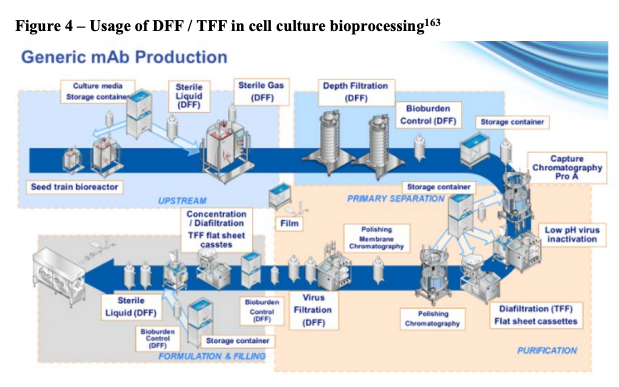
Chromatography resin accounts for ~50% of the manufacturing operating cost and only 5% of the final biologic cost. It’s a low-cost, mission critical product in the manufacturing process. A 1% decline in the chromatography yield can significantly impact the final cost of the molecule:
It's not fair that the protein A price is, like, 5% of the total price for the end product and things like that. It's probably in that range, maybe less, because what they can charge for these products is unbelievably high. - Former Pharmacia Executive
The time and cost of the FDA approval process leads customers to typically qualifying one resin per molecule. This leads to high switching costs:
They are only approved together as one process... If you change your separation method, like using another filtration filter or chromatography resin, you will have a different impurity profile. You have to go back and check with this new resin... It can take years. It's not just a quick fix. — Former Head of Sales, GE Life Sciences
Historically, Protein A resins have dominated the market due to its purification yields:
If you get a cell to produce the antibody you want, then you filter it so there are no solid impurities. You run it through a Protein A column, and what comes out after one step is 98%, 99% pure. In the old days, you needed six, seven, or eight different steps of chromatography to purify insulin. Today, you achieve 98% purity after one step. That is so effective that it's unbelievable…Nothing has the power of a Protein A column. - Former Head of Sales, GE Life Sciences
Cytiva, which Danaher acquired from GE, has historically dominated the Protein A market.
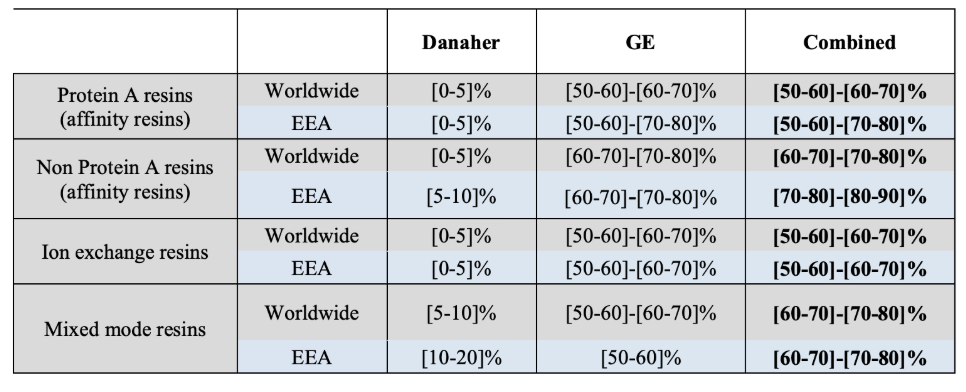
But this seems to be changing.
COVID led to a tight supply of resins. Cytiva couldn’t supply its customers with enough Protein A. This led to two new resin entrants: Merck and Purolite, owned by Ecolab.
MabSelect, Cytiva’s Protein A resin, has been engineered for 30 years to efficiently bind to antibodies and survive caustic cleaning. It has a rigid base matrix that does not collapse under high pressure in large production columns. This makes it great for large blockbuster drugs.
Purolite's Jetted A50 Protein A resin competes with MabSelect with a different bead forming technology. Ecolab has experience in manufacturing more commoditised resins for industrial applications. It manufactures the beads itself but purchases the ligands from Repligen, a frenemy of Cytiva. Ecolab has also poached numerous former Cytiva executives to build out its chromatography business.
Over the last few years, Purolite’s resins are mainly being used by customers for runs in smaller columns. There are questions whether Purolite may pose a risk to Cytiva for larger production molecules:
Customers could say, "I can use a Purolite resin because it is half the price of yours and I am never going to think about going past 60 centimeters, and I manage my bio burden so well I don't need 1 molar sodium hydroxide to clean them up... I am not going to pay your massive increases in price every year." That meant that in the last five years, other companies have managed to walk in with that value proposition that wasn't in existence in the 1990s. — Former Lead, Bioprocessing Resins at Cytiva
Purolite's product requires less cleaning than MabSelect which saves cost:
the real selling point now is you're going to clean out 25% less than you do with Cytiva because of the pressure drop delta. — Former Senior Vice President at Ecolab
And Purolite’s A50 is half the price of MabSelect:
We knew that Purolite was selling their Jetted A50 for something in the region of $9,000 to $10,000 per liter... [Cytiva was] $18,000 to $20,000 for the MabSelect PrismA, which was the flagship resin. — Former Lead, Bioprocessing Resins at Cytiva
Cytiva's Q2 bioprocessing consumable revenue miss is likely a timing issue. The consumables are for commercial runs where MabSelect is specified in the process. While this is true, it's also fair to question Cytiva’s Protein A moat and how it may be challenged by new entrants.
This is the largest competitive change in the resin market in the last 30 years. Our research shares more about the history of chromatography resins, the switching costs, the growth of Purolite, and the competitive response from Cytiva. We also plan to publish a reference check on Julie, Danaher’s new CEO:
Wise: Kristo Käärmann Reference Check
Wise plc is a UK-based fintech cross-border payment business that serves individual, business and bank customers. Its goal is to lower cross border costs and processing time to zero.
Currently 75% of all wise transactions are instant and its cross border rate continues to decline.
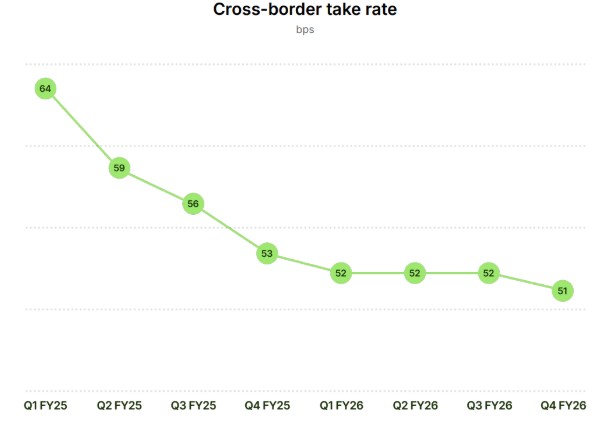
The company is owner-operated with founder Kristo Kaarmann holding 18.23% of the equity and majority voting power. Over the last 10 years, Wise has grown at a 50% CAGR and at 45% CAGR over the last 5 years. It also grew its Free Cash Flow at 25% annually over the last 5 years.
Kristo has been known for keeping a low profile with the media. Kristo’s private personality and recent conflicts with co-founder Taavet led us to study Kristo and the culture at Wise. Over the last few months, we conducted multiple hours of interviews with Kristo’s and Taavet’s former colleagues, all of whom worked directly with Kristo on a regular basis and based in the same office.
This report can be read alongside our other research on Wise:
Related Content

© 2026 In Practise. All rights reserved. This material is for informational purposes only and should not be considered as investment advice.