

Copart & Progressive's Power, Meta's Culture
Here is a selection of interviews published last week. Visit our platform for all research published.
Copart
Copart is trading above a ~5% NTM FCF yield for the first time since ~2015. Jay Adair, the son-in-law who built the business with founder Willis Johnson, has returned as CEO and is making changes:
Jay Adair and Willis Johnson built the company on a scrappy, nimble, get-it-done culture of mutually supporting people... Jeff Liaw brought in a COO who didn't last, and he's the reason I was retired. I believe he had it in for all the old-timers who knew things…The ripple effect of his announcement has spurred enormous excitement... my phone literally blew up... Within 48 hours, there were about 15 promotions from within the company. He's moving quickly. — Former Senior Director of Equipment, Safety & Environmental Compliance, Copart
There seem to be two broad perspectives on why Copart is in its current position:
- It’s losing share to IAA due to Progressive’s growth and there is a risk is share losses will extend to other insurers
- Losses are constrained to Progressive and are self-inflicted
We recently explored the parallels between Progressive’s vendor strategy with both Copart in salvage and CCC in estimatics software. In May, Progressive became the number one US auto insurer, surpassing State Farm for the first time since World War 2. The company is adding ~3m policies per year. And it sends 75% of its salvage volume to IAA and 25% to Copart, the inverse of other top 10 insurers.
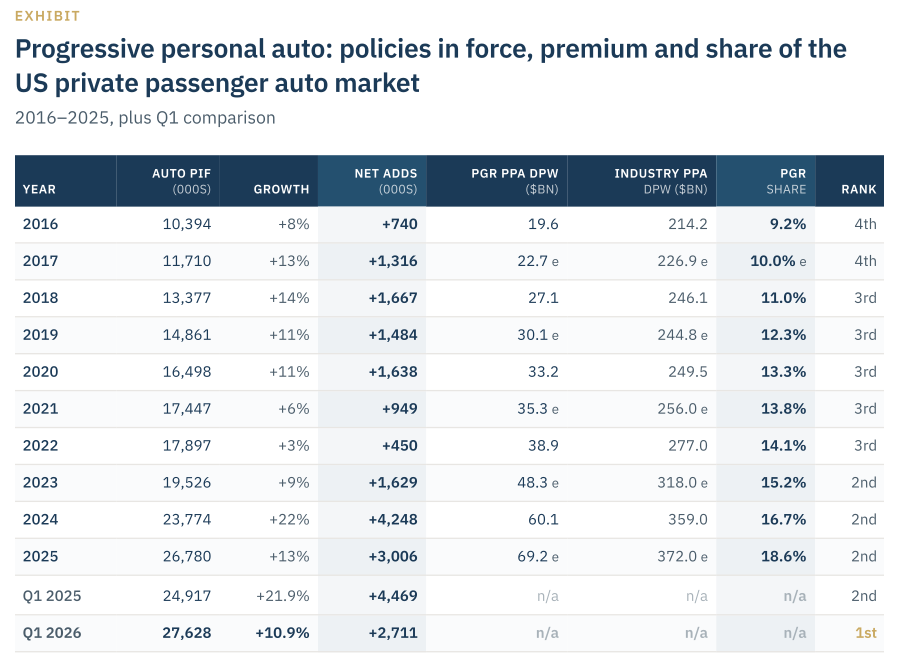
We explore how Progressive negotiates contracts with vendors like IAA and Mitchell. For example, it supposedly negotiated to customize the source code with Mitchell to meet its custom internal workflows.
Progressive uses Mitchell, but the deal they cut with Mitchell was a source code deal. They basically bought Mitchell's source code and tailored it to their own workflow. - Former Chief Technology Officer at CCC Intelligent Solutions
Its scale and recent market share gains mean it can single handedly change the competitive landscape of vendor markets. It dictates service levels given the scale of marginal volume it can shift between players.
By sending 75% of its auto volume to IAA, Progressive enables IAA to increase utilisation, drive efficiencies, reinvest in the service, and compete more aggressively with Copart for other insurance customers. The insurers are also not silly; they don't wish to create a monopoly in their supply base.
The insurance industry dislikes monopolies because they give all the leverage to the monopoly, leaving carriers with none. There are examples where companies with large market shares were countered by carriers funding underdogs to prevent monopolies... — Former Senior Vice President at GEICO
Progressive helps finance the fixed-cost base IAA also uses to serve everyone else. This potentially erodes Copart’s economies of scale advantage.
The risk to Copart or CCC isn't just the loss of Progressive volume, it's the second order effect.
It's Progressive helping finance the growth of IAA and Mitchell to become more competitive and win share from other insurers. We are seeing this now with Mitchell's recent large trials:
The insurance industry is paying attention to Mitchell and the improvements they're making in all of the things they offer, in APD and casualty... the insurance industry, I suspect, would like to see more of a duopoly than an 80% market share. State Farm did an A/B test in 2025; they turned the state of Ohio onto Mitchell... At the end of their A/B test, they must have been happy with the results because they told the repair ecosystem, "We don't care what platform you use." — Former Senior Vice President at a top 3 auto insurer
While Progressive’s share gains has dampened Copart’s volume growth, it’s not the only factor. Cyclicality is another issue:
On cyclical headwinds, we are experiencing the impact of cyclical and, in our view, unprecedented dislocation across the U.S. industry -- the U.S. insurance industry. The 2022 to 2024 inflationary cycle pushed carrier combined ratios out of balance, driving rate increases, which drove consumers to pull back their level of insurance coverage, which was observed through a shift toward higher deductibles and liability-only policies. - Jay Adair, Copart CEO, July 2026
IAA itself is supposedly operationally stronger:
IAA has made significant improvements under the leadership of Ann Fandozzi and Jim Kessler as CEO. They eliminated the bottom quartile of performers... Ann and Jim have improved results, with cycle time roughly 10% better. The average number of days a car stayed in an IAA yard dropped from about 58 to 52. It doesn't mean Copart got worse; it means IAA got better. Now, they are neck and neck. — Former Senior Vice President at a top 3 auto insurer
And some issues at Copart seem to be self-inflicted:
You could see it in the C-suite: three finance people - no operations people - spreadsheet people, face-in-a-book people. Jeff Liaw's version of the world... is that he believes our buyers never want to leave their cell phones and have no need to come in... That may be Jeff's world, but it's not the real world. Nobody in the company ever saw Jeff on the floors of the building, and never saw him in the field. — Former Senior Director at Copart
Copart is one of the most well-covered companies in our library. The following research covers Copart’s recent performance relative to IAA and how Progressive may be indirectly dictating the competitive game in salvage and estimatics software.
Meta's Culture & Advantage+
In June 2022, Sheryl Sandberg stepped down as COO of Meta. She later left the board in May 2024. In our research on Meta’s culture, a former Meta executive believes Sheryl was one of very few people who would productively push back on Zuck.
She was definitely someone who could successfully and productively challenge and change Mark's opinion. After she left, very few people remained who could do that.— Former Head of Product, at Meta Platforms Inc
There aren't many people at Meta who push back on Zuck today. For example, Mosseri, Head of Instagram, and Alison, Head of Facebook, don’t seem to question Zuck’s strategic decisions:
Not so much. They would not go directly against Mark to any great extent." — Former Head of Product, at Meta Platforms Inc
Tom Alison is very calm and humble, and he is much more approachable than Mark. Mark is very intense, and people at virtually every level of the company will think three times before engaging with him directly. With Tom Alison, you can have a casual conversation whenever he is available, debate with him openly, and so on. With Mark, given that he has been founder and CEO for so many years, not everyone is comfortable challenging his points of view or his decisions, and for understandable reasons. — Former Head of Product, at Meta Platforms Inc
Zuck has full control and it seems everyone gets behind his moonshot bets.
You have a founder CEO with a vision, and no one will directly challenge that by saying it can't be achieved — because if you say that, you're out of a job and you forfeit the significant compensation you're earning. So instead, what people say is, "Yes, that's a moonshot, but I need substantial investment to pursue it. — Former Hardware Finance leader at Meta Reality Labs
But at a core operating level, Meta remains rigorous in how decisions are made.
If you want to increase ad load, you have to prove that it doesn't hurt long-term regressions. If you want to drive a new flavor of notifications, we also had a no-notifications experiment that had been running since we started notifications. If you want to drive some changes in notifications, you have to prove it is not regressive against that no-notifications holdout. In terms of how you want to operate as a scientist, an engineer, or a product leader — to have that foresight into long-term engagement impacts is unbelievable. I never had it anywhere else in my career. — Former Hardware Finance leader at Meta Reality Labs
And the adoption of machine learning and Advantage+ is leading to better targeting which drives higher ROAS for advertisers:
A lot of my time, from a product thinking standpoint, was spent on Advantage+, because that was one of the key product initiatives we ran across multiple years. We successfully transitioned a lot of our legacy delivery mechanics into an AI-enabled mechanic through Advantage+... if I were to split it between product-led gains versus machine learning-led gains, it was roughly a 40/40 split — about 40% of gains coming from machine learning, 40% from Advantage+ or similar products, and 20% from other miscellaneous sources. Advantage+ Sales was a good example — it was an all-in product where all levers were enabled using the full Advantage+ dynamic. We saw a lift of 11% to 17% improvements in CPAs or ROAS that advertisers would observe - Former Director of Data Science at Meta
Our research covers Meta’s culture, Zuck’s leadership, Reels and Core ad loads, and AI targeting in more detail in the interviews below:
Related Content

© 2026 In Practise. All rights reserved. This material is for informational purposes only and should not be considered as investment advice.