

A collection of interviews published last week. Visit our platform for full coverage
Published Last Week
Belron IPO
Belron, owner of Safelite, the largest US automotive glass repair service provider, is due to IPO at a proposed 30bn to 40bn EUR. The company fits what we look for: predictable aftermarket recurring revenue, favorable cash unit economics, and a dominant market position.
Belron processes and repairs glass claims for US insurers. Its scaled shop network provides the lowest cost per windscreen claim for insurers. It has an estimated ~70% market share in US insurance glass claims.
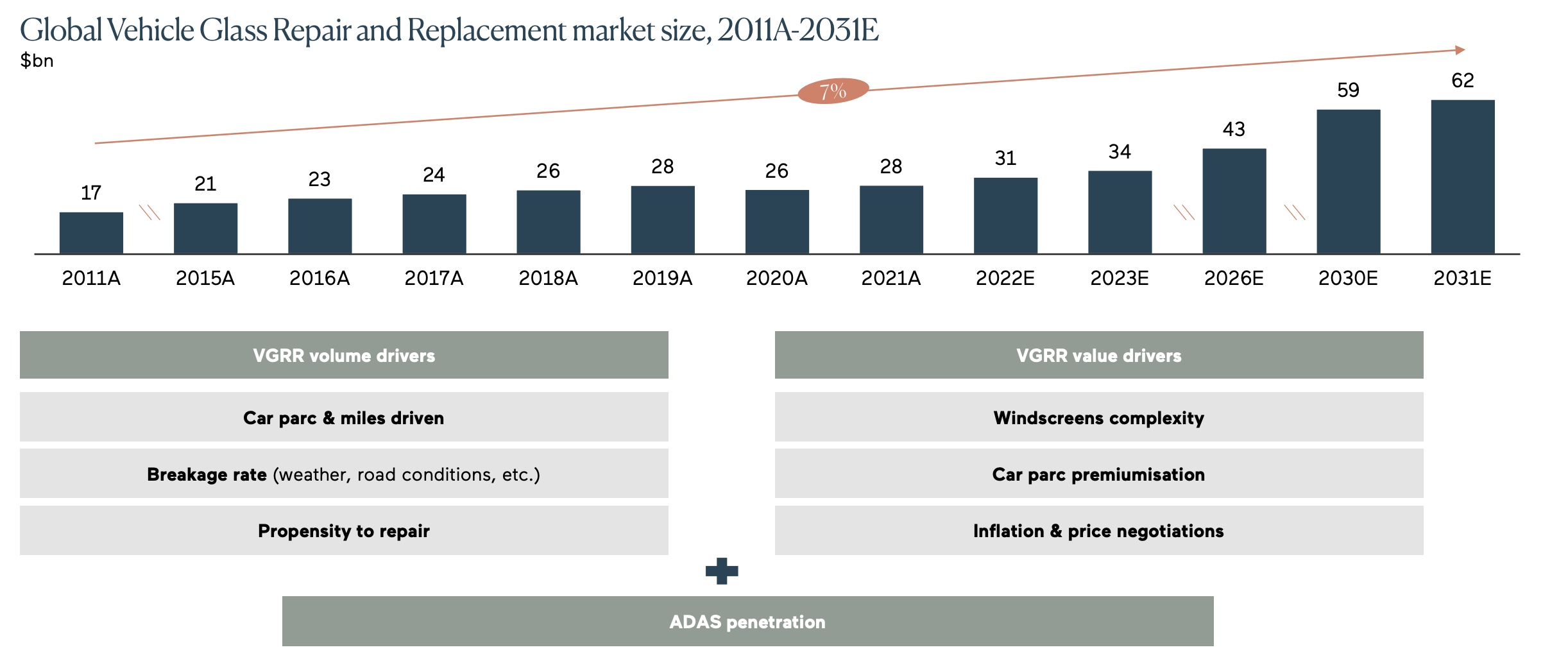
But glass claims and windscreen replacement unit volume isn’t growing. The number of glass replacements excluding recalibration grew 0.4% YoY in H1 26.
Belron’s growth algorithm is driven by price as follows:
market prices are going up about 6% a year: 2% from glass, 2% from labor and 2% from the recalibration fee. - Former CFO of Belron
An increasing calibration mix, due to more complex glass, plus operating leverage has led Belron’s EBIT margins to increase from below 10% in 2015 to over 23% last year.
But the recalibration tailwind won’t last forever:
I think about 54% of all windscreen jobs now need recalibration, and it is going up by 7 percentage points a year. In about six years' time, they will lose that additional 2%. - Former CFO of Belron
In 2024, 1-2% of Belron stock traded for ~20x EBITDA between minioriy shareholders. Aty the time, prime job volume growth was ~1.5%. Today, job volume growth is flat. What price should Belron trade at if unit volume starts declining, excluding recalibration?
If market volumes start to drop, at -1% per annum, then Belron will start going at -1% per annum, because they have not got the opportunity to gain a lot more share. If that happens, with the fixed costs, you cannot take 1% of your cost base out... - Former CFO of Belron
We plan to publish multiple more interviews on Belron ahead of the IPO covering US insurer relationships and how insurers view Safelite over the next week.
- Driven Brands: Auto Glass Acquisition Integration - 17 Feb 2025
- Driven Brands & Auto Glass Repair: Competing vs Safelite - 30 Dec 2024
Purolite winning share from Cytiva
In 2021, Ecolab acquired Purolite, an industrial and life sciences resin manufacturer. We estimate Purolite’s jetted chromatography resin business has grown sales 3-4x since the acquisition. Purolite seems to be taking considerable share from Cytiva in clinical trial manufacturing.
As we’ve stated before, chromatography resin accounts for ~50% of the manufacturing operating cost and only 5% of the final biologic cost. It’s a low-cost, mission critical product in the manufacturing process. A 1% decline in the chromatography yield can significantly impact the final cost of the molecule:
It's not fair that the protein A price is, like, 5% of the total price for the end product and things like that. It's probably in that range, maybe less, because what they can charge for these products is unbelievably high. - Former Pharmacia Executive
We spent three hours interviewing the person who built the Purolite A50 jetted business that competes with Cytiva’s MabSelect franchise. We explore how Purolite has won clinical manufacturing clients:
I said the way we were going to build market share was to get into early-phase clinical trials and win as many clinical programs as possible before they moved into Phase 3. Once you are in Phase 3, there is resistance to changing your process, and you need some fundamental major reasons to make changes at that point. It was more in clinical manufacturing that you would use the resin a handful of times, less than five, less than 10, but certainly nowhere near the hundreds of cycles it was designed for, which they were buying it for but never using it for. - Former Leader of Purolite Life Sciences, Ecolab
And how Purolite’s bead technology could compete with Cytiva:
We were able to show that when you have beads of the same size, there are fundamental gains for us as a manufacturer, but also for manufacturing processes. In the polishing steps, that was particularly beneficial. As I explained at the very beginning, chromatography is a diffusion-driven process. Your molecule of interest needs to go inside the bead and stick to the ligand, then you need to be able to reverse that interaction, whether through a reduction in pH or reversing pH, which we call elution. Then you get your molecule of interest. Think of a flow path from the center of your bead to the outside. If you have a wide distribution of bead sizes, your on/off rates are different, so you will have different peaks coming off. In a polishing step, you want a very nice tight peak.- Former Leader of Purolite Life Sciences, Ecolab
We also explore how Purolite designed its bead considering caustic cleaning processes to create a resin that leads to a customer yield on par with Cytiva:
What I have just described, where you improve the lifetime of the resin because you only clean every fifth or every 10th cycle, would also apply to Cytiva. The fix on caustic sensitivity so that we could get equal life—that was also done in the first two years. That turns out not to be a product people really want, at least from Purolite at this stage, because we're not in substantial long production runs, except for a couple…The yield between the two products was no different. Neither was better than the other. - Former Leader of Purolite Life Sciences, Ecolab
A critical question is how Purolite’s product can perform in longer, late stage manufacturing processes. Or will clients switch to Cytiva when they need longer cycles?
We explore how a customer may choose resin in light of changes in FDA guidelines, continuous manufacturing, and mab complexity:
Today, the direction of the industry is interesting. Before, when Cytiva essentially owned the marketplace, they dictated the price. But now competition has come in, and you are starting to see Protein A almost become a commodity. You have Chinese exporters also trying to get into this space, which is driving down the cost, so people are now going back to the innovation side and asking how they can make Protein A better than it was before. We are starting to see more domain modification changes and base bead product changes. - Former Leader of Purolite Life Sciences, Ecolab
- Danaher: Cytiva / Pall Strategic Integration - 20 Jan 2026
- Cytiva vs Sartorius: A Vaccine Customer's Perspective - 25 Nov 2025
LVMH Family Succession
We’re running a reference and culture check on LVMH and Arnault’s children as potential successors. We’ve published four interviews with executives who worked closely with multiple different children. Alexandre led a turnaround at RIMOWA:
We did in two years a turnaround that would take a decade in other companies, because we were protected, he was bold, he pushed us, and we were managing to generate the basis for a great success. - Former Executive at Rimowa
And less quantitative focused:
I have never seen any quant analysis, reaction or discussion from him. It was always very qualitative and comms-focused, even within marketing, not even the ROI side of things. - Former Manager at Tiffany & Co, LVMH
Alexandre seems to be compared favourably to Delphine and Fredric:
nobody really wants to work for her, which is not the case for Alexandre. People want to work for Alexandre. - Former Executive at Rimowa
I know Frédéric Arnault a little, the second son of Hélène Mercier, Mr. Arnault's second wife. He did watches and jewelry, and now he is at Loro Piana. I know him for what he did in watches and jewelry. He was a very young manager, willing to demonstrate to his dad that he was up to whatever task was given to him. He had no patience at all, and he almost broke the brands in watches and jewelry. How did he manage to do so? At TAG Heuer, he changed his management committee almost twice in two and a half years. Nobody was good enough because he wanted the moon, and to get to the moon, you need to build a rocket, which takes a lot of time and studies. It felt like being Elon Musk without being as clever as Elon Musk. - Former Executive at LVMH
The interviews go into more detail on culture and operating strategy at each firm Arnault’s children are currently running:
- RIMOWA: Vertical Integration & Alexandre's Strategy - 11 Nov 2026
- Hermès: Kelly-Birkin Allocation Strategy - 05 May 2026
Copart vs IAA
Last quarter, multiple former Copart executives implied IAA have discounted to win Progressive and other large insurer salvage volume:
Progressive is entirely pricing-driven. Copart is at a point now where, at one time, they would bend a lot more to get that book of business. I don't think they are willing to bend enough for Progressive. That is Progressive's statement — that Copart would not give them what they wanted. I don't think that is anything to be too concerned about as far as Copart's other insurance customers or their ability to maintain those types of relationships. That is just a Progressive thing, and Copart has always had a back-and-forth relationship with Progressive anyway. - Former Sr. Manager at Copart Inc
All the insurance companies might be feeling good about IAA because they're talking big and reducing prices - Former Senior Director at Copart
Here is another perspective:
At a high level, across all areas but particularly in tow and title, our SLA performance is in the high 90s now, up from title in the high 80s and tow in the low 90s. With a target of about 95%, we are now exceeding the target consistently. What you are saying is out in the marketplace, but my guess is it has been embellished some... I don't know of any deal where we were giving the house away; I think that is just an exaggeration. - Former Executive Vice President at RB Global
© 2026 In Practise. All rights reserved. This material is for informational purposes only and should not be considered as investment advice.