

TransDigm & GE vs Airbus, Meta & Amazon Culture, AppLovin
A collection of interviews published last week. Visit our platform for full coverage
Published Last Week
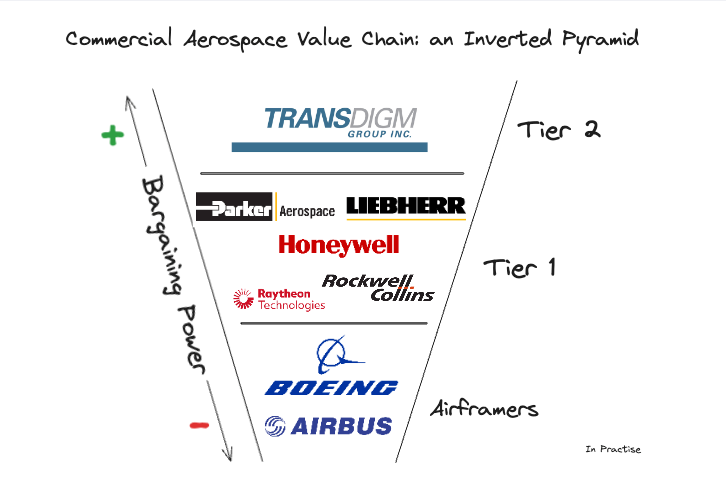
The commercial aerospace value chain seems to operate as an inverted pyramid: airframers design and certify the aircraft yet have increasingly relied on OEM suppliers to design and manufacture the parts to meet its type certification.
The certification process inverts the bargaining power in the value chain: once a supplier is on a platform, it’s uneconomical to recertify the parts to substitute the supplier.
But the airframers are looking to change this.
Prior to the 1990s, aircraft OEMs were vertically integrated and produced aerostructures, interiors, and other systems in house. Local production facilities were combined with in-house engineering who handsketched aircraft designs. Supplier activity was limited to individual parts and subassemblies; Boeing would design and engineer the parts internally and subcontract manufacturing to build-to-print shops.
This changed in the 1990s as the globalisation of trade created a single commercial aircraft market. Digital drawings made it possible to source parts globally. The aerospace industry followed Toyota's Lean methodology and birthed the Tier 1 OEM suppliers.
Today, Airbus owns <20% of IP on its typical airframe. It outsources the design of most systems. This has proved challenging:
Under the original framework, a massive portion of the IP was conceded to the OEMs, and Airbus encountered severe operational friction after taking over the program. Components were bundled and sold strictly as completed modules rather than individual piece parts. This setup prevents you from building a competitive pricing catalogue; if a sub-component fails, you are forced to replace the entire module. - Former Senior Executive at Airbus
Not only did it drive a higher cost of operating, but the OEMs captured the majority of the aftermarket profit pool. Airbus now seems to be actively looking to insource designs on future platforms. APUs are a target. And Airbus may even go after narrowbody engines:
If you are asking me whether they can do it, I think they can. Will they go all in? I think they will try to convince the OEMs to play along with them. I do not see them going alone, because if you take a company like GE that has invested over the years into different programs — military programs included — the information and data they have accumulated is extensive. It has to be a joint program, in my view. On an APU, they could do it themselves, but on an engine, I see that as a joint program. - Former Senior Executive at Airbus
Airbus and Boeing claiming back more ownership of the aftermarket is a terminal value risk for OEMs. It's particularly a risk for OEMs that are on legacy platforms. The average age of an aircraft is ~14 years and Airbus has a similar backlog. As aircraft retire, OEMs must win content on new platforms to continue riding the wave of structural organic growth in kilometers flown.
A risk to TransDigm is that it doesn’t reinvest enough in R&D (<1.5% of revenue) to win new content and is perceived to increase aftermarket pricing more than others.
TransDigm Group aggressively increased their aftermarket pricing right after Covid-19 into the 17% range. This triggered intense negotiations between TransDigm, Airbus, and Satair. Under severe pressure from Airbus, TransDigm ultimately conceded to a moderated pricing model. While they still secured a substantial price increase above the historical 7% baseline, it was capped at roughly 12%. - Former Senior Executive at Airbus
TransDigm also mainly sells via distributors. This can limit the feedback loop between airlines and TransDigm to understand and improve part performance.
On one platform where TransDigm was bidding, there were 16 different suppliers bidding, all qualified. They would not even be part of the bidding process if they did not qualify. It then comes down to engineering, design, guarantees, mean time between removals, and warranties — everything plays into the decision. If I look at them, they focus heavily on profitability and cost — that has always been their focus. They do not have a large sales team in their business units. They rely heavily on distribution channels to sell their products through either direct sales or distributors. - Former Senior Executive at Airbus
Hypothetically, let’s say TransDigm doesn't win new content on new planes. What could they do?
One idea: PMA.
And, more specifically, PMA’ing competitors’ parts.
This may partly explain TransDigm’s willingness to buy Jet Parts at a much higher premium to what HEICO paid for Wencor. A test and computation PMA, effectively reverse engineering a part, is an alternate strategy for OEMs to win qualified content on new aircraft. Maybe the acquisition of Jet Parts forms the basis of a defensive strategy in the event it can't win much content on new platforms?
While these are very long term risks worth considering, the current level parts overstock, the Iran war pressuring RPKs, and the upcoming retirement of aircraft are shorter term pressures for the company that we explore in detail.
I think there will be a change, and the market will slow down a little next year, especially on the parts side. - Former Senior Executive at Airbus
The interview goes on to explore Airbus’ aftermarket strategy, Airbus' perception of TransDigm, aftermarket overstock, and the risk of Right to Repair to TransDigm in the following:
Running a low margin e-commerce business at scale requires a high standard of operational excellence. A truly cost conscious culture. On the other hand, high margins can encourage less rigorous governance and operational procedures. The evolution and culture at Amazon vs Meta seems to exemplify this perspective.
Zuckerberg seems to run Meta’s strategy in his head. And it has created a culture in which it seems very difficult to question him:
Mark Zuckerberg has the strategy in his head and does not share it. You might have a roadmap for custom silicon that everyone is marching toward, then at 11 o'clock the night before, Mark decides to add a program to the roadmap. Programs get canceled, programs get added, and suddenly you are telling TSMC you need more capacity or need to change something that has already been taped out. Billions of dollars are being committed, and it does not matter — Mark said it, so go do it. There might be no demand for that chip; the business might not even want it. But Mark wants it, so it gets built… I jumped in and said that this did not make any sense from a finance point of view. Afterwards, I got a talking-to — "we don't do that here." I said, "What do you mean? This makes no financial sense whatsoever. Do we just sit there?" The answer was yes — you sit there, you agree, and people go off and run with it. - Former Senior Executive at Meta and Amazon
The board included:
Every day was like that. I would write up these enormous approval documents and send them out. At AWS, it would take a few weeks for the board to sign off, and they might have questions that I would have to prepare answers for. At Meta, I never received a single question or pushback from anyone on the board. It was typically DocuSigned within a day. Is Dana White really going to question a $50 billion GPU purchase commitment? No — they do not do that.- Former Senior Executive at Meta and Amazon
The loose governance and culture also seems to seep into capital allocation:
They were not even doing a total cost of ownership analysis until I got there two years ago. They were building all these chips and nobody could tell you what the TCO was or how it compared to alternatives. At AWS, we would go through that down to the penny, and every leader knew exactly how the model worked — they could explain it in detail and discuss how to drive a penny, two, or five out of it. At Meta, nobody really talks about cost as it is not a priority. Meta is at roughly the same scale as AWS in terms of racks shipped, data centers, and support. At AWS, we had 300 people in infrastructure finance. At Meta, I got up to about 50 people total in my organization. - Former Senior Executive at Meta and Amazon
This also seems to create a more chaotic culture:
First, Meta is all about individual impact — that is the number one priority. In performance reviews, it is not about what your team accomplished; it is about what you personally accomplished. There is no "there is no I in team" mentality. Everyone is running off in a million directions with no clear shared strategy. - Former Senior Executive at Meta and Amazon
Amazon seems to be run in stark contrast to Meta:
I sat in a lot of meetings at Amazon and thought, I am working with the best business leaders. I owned my space — there was nothing that Brian Olsavsky, Andy, or Jeff Bezos would ask me that I could not answer. The AWS CFO might have two questions for me per quarter because he knew I owned it. At AWS, there are strong processes like OP1 and OP2. We would spend all of April and May writing detailed documents outlining the strategy for the following year. Those documents would get vetted all the way up to Andy. We would be in rooms with 30 people, with Andy Jassy and Brian Olsavsky firing questions at us and pressure-testing the strategy. - - Former Senior Executive at Meta and Amazon
You can read more about Amazon and Meta culture in our new IP Reference product, CEO reference checks with direct reports and colleagues of senior leaders.
AppLovin
The growth and adoption of CloudX seems a potential risk to AppLovin's organic growth:
It's a very promising product built by the OG's who founded MoPub, MAX, and other platforms — Jim Payne and Dan Sack. The resumes are among the best in the world right now. Jim was also a very early employee at AdMob, if not a founder. It's an exceptionally strong team. My understanding is that they're currently strongest in non-gaming. They can also be strong in gaming, but they face a bottleneck on the network side — can they really compensate for publishers who are losing 30% of their ad spend by leaving AppLovin? Right now, the answer is no. For non-gaming publishers who aren't as dependent on AppLovin, and for whom being on AdMob or CloudX doesn't significantly affect their Google campaign effectiveness, it works well. The biggest expectation from the market right now — and I heard this at AppLovin's recent event in Croatia — is CloudX getting approved for Google Bidding. If they get certified to support Google Bidding in real-time, that would make things considerably more competitive. - Former Director at AppLovin
Read about this risk and more:
Related Content

© 2026 In Practise. All rights reserved. This material is for informational purposes only and should not be considered as investment advice.