

Shopify Payments, Otis & KONE, Applovin DTC, Coreweave
Published Since Last Update
Shopify Payments
Shopify’s Merchant Solutions business now seems to account for over 70% of incremental gross profit dollars, despite carrying a ~38% gross margin versus ~80% for Subscription Solutions. And over 85% of Merchant Solutions revenue is estimated to be payment processing and FX fees.
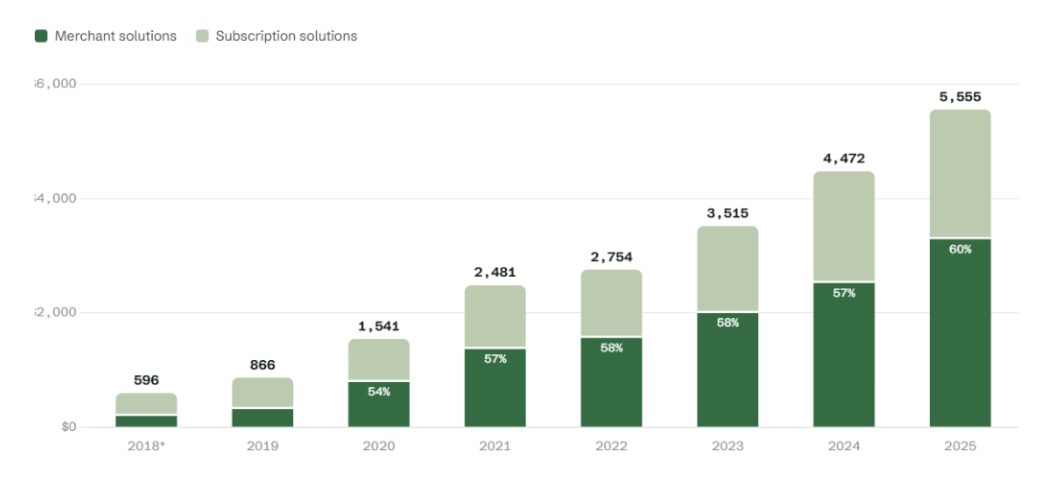
Prior to 2023, Shopify only worked with Stripe as a processing partner:
Before 2023, Shopify only had Stripe as a back-end payment partner, so even if they wanted to pressure Stripe for a better rate, Stripe knew Shopify had nowhere else to go. Once PayPal was added in 2022, Shopify gained some leverage, and basis points came down fairly quickly. Then heading into the 2026 renewal, Adyen secured a contract with Shopify, which means Stripe now faces the real risk that more volume could shift to Adyen across different markets. - Former Head of Payments Platform Partnerships, Shopify Inc
Shopify realised Stripe wasn’t competitive in local markets which led to the adoption of both PayPal and Adyen:
Shopify executed the exact inverse strategy vs Toast Corporate leadership initially declined to pursue an independent Payment Facilitator license and outsourced their core infrastructure to Stripe. By 2020 and 2021, Shopify realized that Stripe lacked localized processing competitiveness across international markets. To remedy this, they ran a competitive evaluation between PayPal and Adyen. Leadership ultimately selected PayPal, which proved to be a strategic miscalculation. Near the conclusion of my tenure, we were finalizing a global secondary processing partnership with Adyen to manage our transaction routing outside of North America. - Former VP, Global Sales at Shopify
Adding multiple processing partners has partly led to an increase in Shopify’s net processing take rate:
The net take rate, not the gross we've been discussing. That is whatever Shopify charges the merchant minus what we pay to Stripe, or to anyone else minus the buy rate they've given us, as well as any chargebacks, fraud, or liability that Shopify carries. That number actually increased by almost 20% over the last three or four years - Former Head of Payments Platform Partnerships, Shopify Inc
The biggest contributor is definitely the cost reductions negotiated with Stripe four years ago, Shopify's volume was around $100 billion to $150 billion. This year, they are probably going to cross $450 billion. PayPal and Braintree were added in 2022 at very aggressive pricing. PayPal was actually priced at an interchange-plus cost to Shopify rather than a blended fee, and within that model, they charged the minimum possible amount. That arrangement launched in 2023 with France, where PayPal was the only provider for the last two to three years. Then in March of this year, Adyen was also added, and from what I have heard, Adyen has since replaced PayPal in France. PayPal was also added in the US as a secondary provider. Even comparing Stripe's high single-digit margin to PayPal's very low margin, that addition improves Shopify's overall margin over time - Former Head of Payments Platform Partnerships, Shopify Inc
Net take rates seemed to have increased yet Merchant Solution gross margins are stable. This is partly due to mix:
We successfully scaled that specific business from $100 million to well over $2 billion in ARR within a three-year period. Shopify supports approximately three million total platform customers, creating an incredibly long-tailed revenue distribution. More than 2.9 million of those accounts are small scale entrepreneurs and early stage trials. The upmarket enterprise segment consists of several thousand managed merchants rather than millions. - Former VP, Sales at Shopify
Some of Shopify’s largest deals, like Estée Lauder, have take rates of ~2.05% and a total take of ~2.25% of GMV. This compares with 3.55% of GPV that Shopify earns in Merchant Solutions across its whole base. Add subscription revenue (0.73% of GMV) and a typical merchant fully on Shopify Payments is worth about 4.3% of GMV, against about 2.25% for a deal like Estée Lauder.
The Estée Lauder agreement was structured with a subscription platform fee of approximately 0.2% assessed against total GMV. The blended payment processing rate was established at approximately 2.05%. Former VP, Sales at Shopify
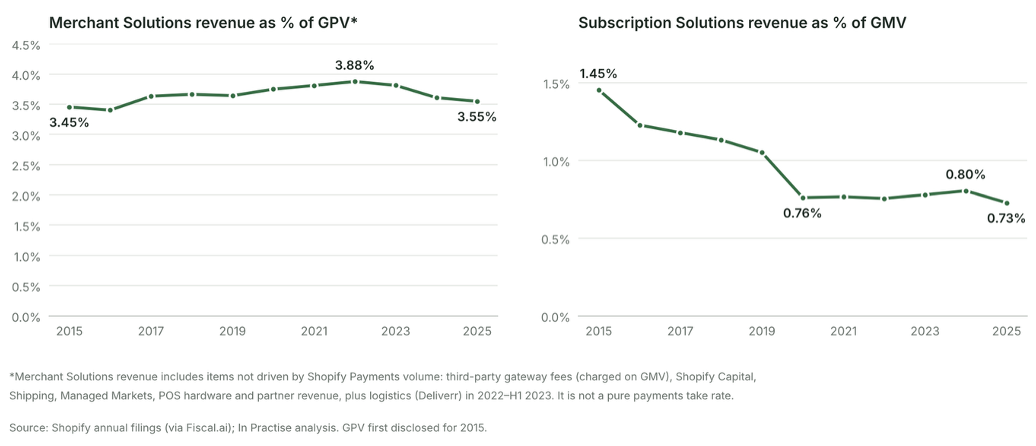
Shopify’s payments break-even in the US is reportedly ~1.7% of volume.
Shopify's domestic break-even cost floor in the United States averages approximately 1.7% of transaction volume. Therefore, on the Estée Lauder agreement, Shopify captures a net transactional margin representing the spread between the 1.7% cost basis and the 2.05% merchant charge. - Former VP, Sales at Shopify
Coreweave vs AWS GPU depreciation rates
Many believe current rental prices of H100 and other chips support a 5-6 year GPU life:
That is not to say H100 or A100 is trash today. There is still a market for that, and I remember reading that the spot price for those GPUs is still rising. There is a case to be made for the useful life extending well beyond that three-year sales window. That is why I still think the five-to-six-year estimate is a fair assumption. - Former Infrastructure Finance, Amazon Web Services
A former AWS executive argues that Coreweave and hyperscaler GPU depreciation rates should be different because of the ability to monetise the asset and the distribution of customers. AWS has more customers and workloads to redeploy GPUs as contracts roll off in 5-6 years:
I do not agree that CoreWeave should depreciate its technology over six years. If I am AWS, I probably have a different perspective, because I can find homes for those old GPUs. I have enterprise customers that would probably use them, and lots of needs for internal training. I just don't see where CoreWeave, Nebius or Lambda are going to use them if there is rental compression. - Former Global Executive, AWS
Otis and Kone Elevator Maintenance
Otis seems to have a ~90% attach rate of services on new elevators:
I am trying to think back to when I was in the industry. It has to be pretty high, at least 90%, if not more. The things I would have been involved in were the really high-value contracts, and I am trying to think of the high-value contracts we knew would be coming off warranty that we wanted to win and did not win. There were not a whole lot of those that I remember, and those stand out when they are a big deal. There may have been one or two, but a lot more of them do come through. - Former President, Otis Americas at Otis Worldwide
But this has decreased over time:
When I left, the cancellation rate was around 11% across the country. ... Back in the late 1990s and early 2000s, if the cancellation rate got above 3%, people would go crazy. - Former Regional Manager at Schindler Corporation
Price competition, product quality, and ISP competition are drivers of increasing maintenance churn. We discuss each of these in the following work:
there were one or two scaled ISPs under PE ownership that were growing via roll-up, and we would see them come in. The hard part was that sometimes they could meet 80% of what was asked on the RFQ, and there were things we knew they were not going to be able to do, but their price might be terrific. - Former President, Otis Americas at Otis Worldwide
Applovin DTC adoption
Applovin doesn’t break out quarterly DTC revenue. We published three interviews with customers of Applovin's DTC products to review adoption. Each customer is ramping spend:
At the start of last year, AppLovin was 2% of our spend, and we ended 2025 with it at about 11% of spend. This year, we started at about 11%, and we have been in the 11% to 15% range for most of the year. - Vice President, Growth at a DTC Customer of AppLovin
But customers seem to see ROAS degrade at relatively low levels of spend:
You can see here that CAC jumps very starkly as soon as we hit the $30,000 per day threshold. ... our belief is that the users within their ecosystem are capped off. - Head of Growth at a PE-backed DTC apparel brand
We do start to see diminishing returns at a point. Without giving exact numbers, we have come close to the edge of seven figures in a month on AppLovin, so it is a very big piece of our media spend, and that is where I have seen the cap. - Associate Director of Growth at DTC CPG Delivery Company
The interviews explore why the ROAS degrades, how each brand is testing Applovin, and the long-term opportunity in DTC.
Related Content

© 2026 In Practise. All rights reserved. This material is for informational purposes only and should not be considered as investment advice.