

We’ve added two new datasets to our platform:
- IP Podcasts: ~300 of our favourite business podcasts plus new shows added daily
- Earnings Calls: public company earnings call transcripts from Quartr
We aim to bring our proprietary library to life by making our expert interviews queryable alongside other datasets. Over the next few months, we also plan to add:
- IP Forensics: forensic accounting analysis of every company IP covers
- IP Transactions: tracking purchases and sales of US company insiders
- Financials: financial statements and KPIs of public companies
- Agentic research workflows: agents to help you conduct fundamental equity research across our platform
Earnings Calls
You can now compare what management says in earnings calls with what former operators are saying within our expert interview library. We aim to surface and display disconfirming or supporting evidence as you read earnings calls:
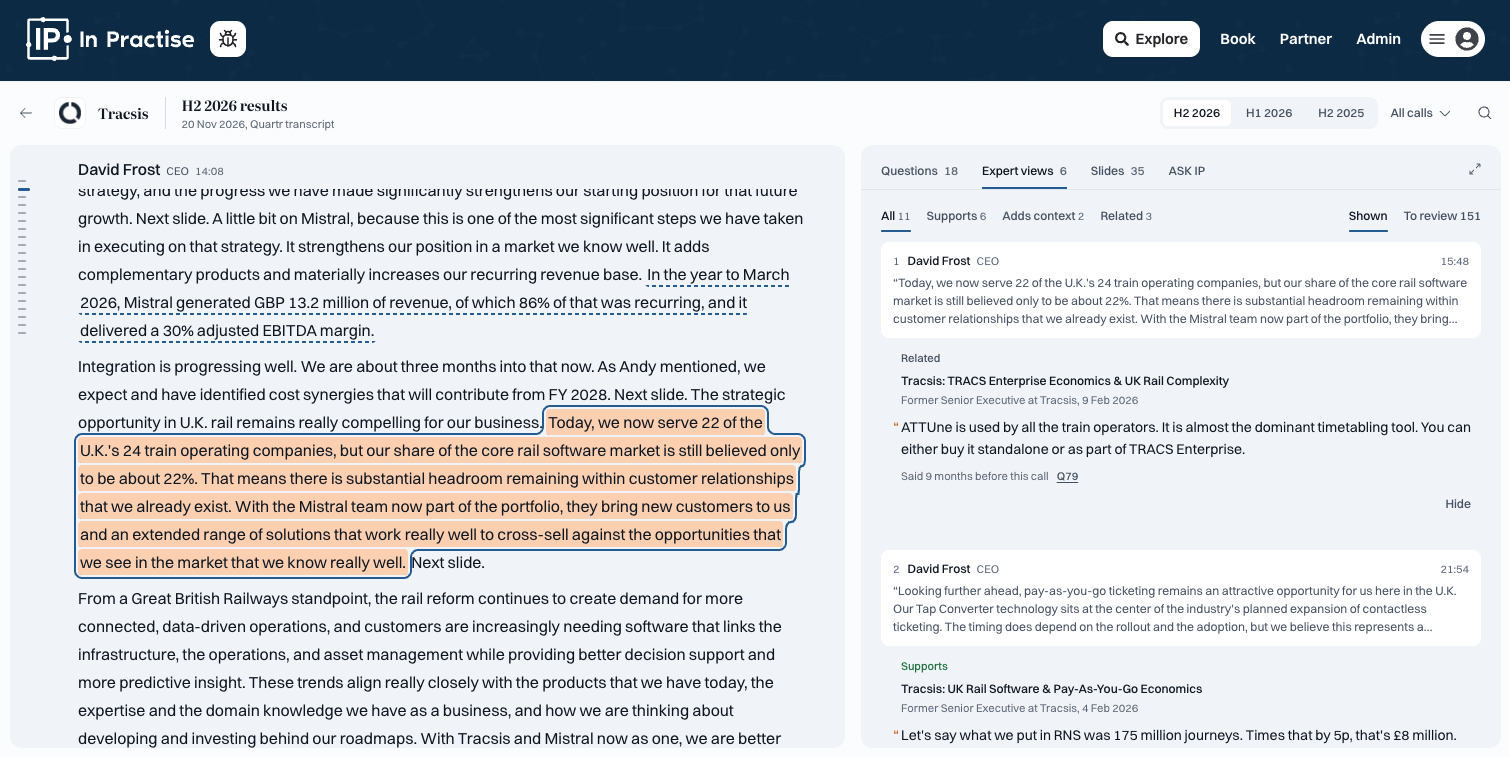
Querying across datasets can have signal. For example, in January, a former Trade Desk manager told us that Amazon's DSP (demand-side platform) would take share from other DSPs during 2026:
Throughout 2025, Amazon's prominence and the expansions they've made to their DSP in terms of feature sets and partnerships has expanded and grown. Amazon is also incredibly competitive in terms of their rates as well. They can be incredibly competitive because for them, their DSP is a tiny fraction of their major business. They can afford to take risks and pay to acquire market share. For me, this year, when you look at the whole market, we'll see Amazon take share, and that will come from the more expensive DSPs, of which I think The Trade Desk is probably one of them. - Former Manager at The Trade Desk
Five weeks later, CEO Jeff Green said competitive pressure had ‘not really’ increased, and that Google had been the stronger competitor:
Has the competitive pressure gone up? I would say, not really. Let me explain why. People want to talk about Amazon a lot as it relates to competition, as I said before, I think Google was a far better competitor than Amazon is today, or frankly, will likely ever be. - Jeff Green, CEO, The Trade Desk, Q4 2025 earnings call, 25 February 2026
Two months later, a former Amazon Ads manager said advertiser budgets were shifting from Google and The Trade Desk towards Amazon:
I would say that Google and The Trade Desk would have been major players in the past years. Now, if you're looking at what the majority of advertisers are capitalizing on and leveraging - first-party data, realistic and relevant data for their advertising - the budgets would be shifting towards Amazon DSP at the moment. - Former Manager at Amazon Ads
In August, The Trade Desk missed guidance: Q2 revenue was $715m against at least $750m.
In some cases, budgets have been temporarily reduced as they formulate new plans to go to market. In other cases, some brands are falling prey to low-cost, low decisioning methods like Programmatic Guaranteed and fixed price. Doing so essentially means buyers will give away their decisioning in a great buyer's market to the sellers in exchange for lower cost of transactions. - Jeff Green, CEO, The Trade Desk, Q2 2026 earnings call, 6 August 2026
Podcasts
We have transcribed and tagged the backlog of ~300 business podcasts for you to read and query alongside our expert interview library. You can also suggest specific podcasts and episodes for us to process and distribute on the platform and through the MCP.
Given the rigid structure of earnings calls, there is often more signal in longer, unstructured conversations with CEOs on podcasts. For example, Andy Jassy recently said on the a16z podcast that 'a good chunk' of AWS compute capacity for 2028 was ‘already sold out'. This claim can now be cross-checked with expert interviews, earnings calls, and podcasts on our platform using Ask IP.
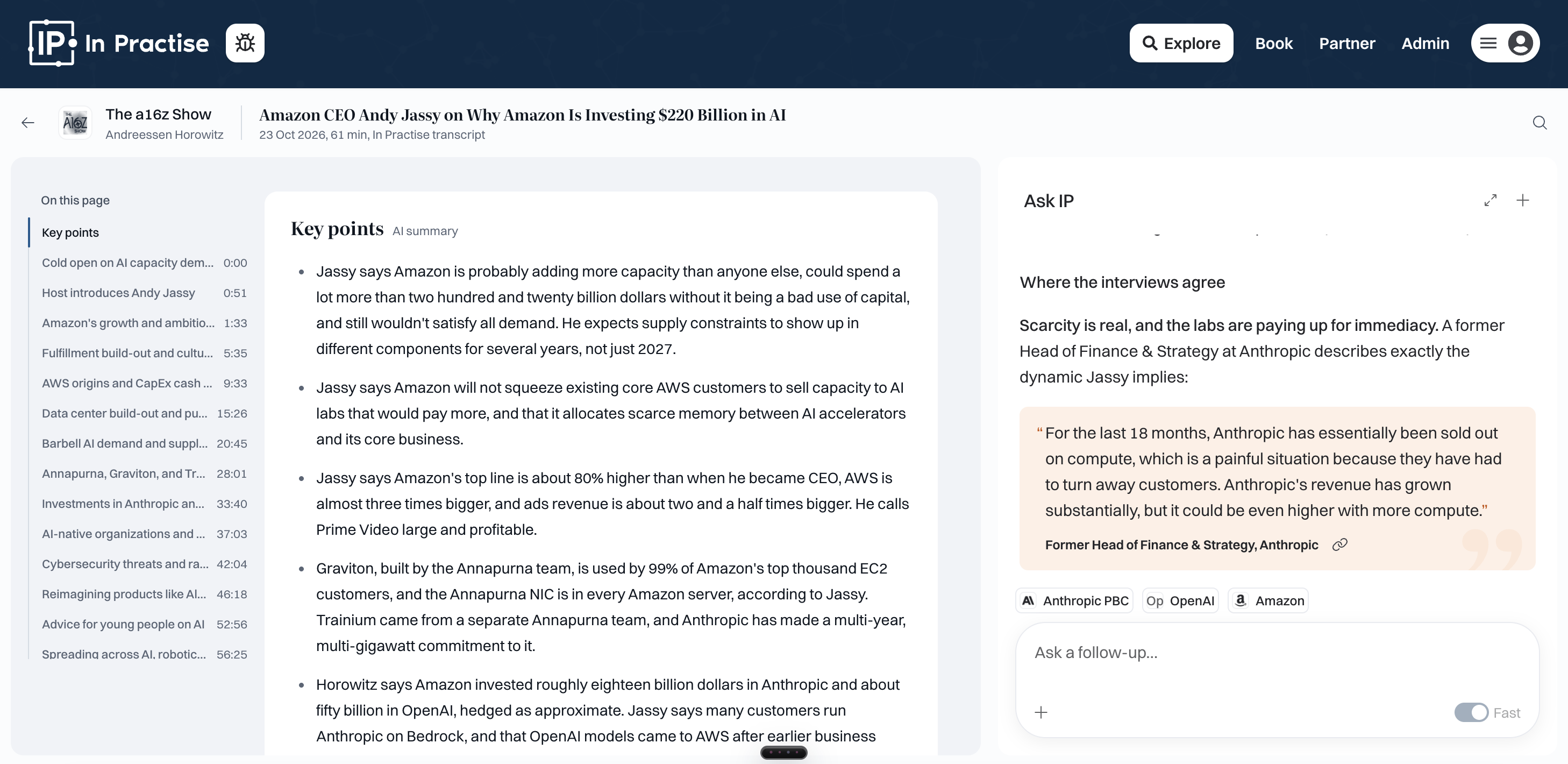
An example of the value of querying across all datasets is illustrated by the following question: how is AI changing the travel booking experience and who will own the traveller when an AI agent books the hotel?
According to the Booking CFO, agent referrals are well under 1% of Booking.com room nights. He argues that agents prefer to connect to aggregators:
They are still figuring out their economic model. They haven't really come to a conclusion there because the competition is very high. We get the vast majority of the traffic because they like to connect to aggregators. That is much better for them, and that is good for us. From an economics perspective, the diversification looks like it is going to be a positive for us at the end. - Ewout Steenbergen, CFO, Booking Holdings, Q3 2026 earnings call, 3 November 2026
Booking CEO Glenn Fogel argues that small and medium-sized hotels need Booking to be found by agents:
so much of it is the small, medium-sized ones who do not have the resources, who absolutely are afraid that in the new world, they will not be seen at all. But that is okay, because we are there to provide them what they need. (…) or now it is, "How do I show up in an LLM? (…) How is my agentic horizontal going to find me, see me, or whatever?" We are there to provide it for them, and we do it at a risk-free rate. - Glenn Fogel, CEO, Booking Holdings, Q3 2026 earnings call, 3 November 2026
An IP interview with a former Booking.com supply manager thinks the risk is on the customer side, not the hotel supply:
This question gives me a bit of déjà vu from the past when Google started with the Hotels Finder, and there was discussion about whether this would cut out the OTAs. I see [disruption] more on the demand side. Consumer behavior will change in times of AI. Think about the normal traditional website where you type in a destination and dates - that is how old-school structures work. With AI, it is a lot about free text personalization. You can surface way more content via photo intelligence, reading what is on the pictures, or reviews or comments. You could plug in the supply directly, but what is not replicable is the whole trust part, because there is a huge operational engine behind it. Phishing and fraud is a topic which grew massively over time. It is not a simple plug and play. There are a lot of things that happen within that supply. - Former Regional Manager, Supply at Booking.com
In another IP interview, a former chief sales officer at HBX, a hotel bedbank, argues that agents could reduce Booking.com and Expedia to a booking API and take ownership of the customer:
What will likely happen is that any of these gen AI solutions will take over the user experience on Expedia and Booking.com. At the end, Expedia and Booking.com might be commoditized to just providing the product via an API so you can book, buy, and reserve on the ChatGPT engine, even though the transaction, the booking, and the reservation remain on Expedia or Booking.com. (…) That means losing customer ownership. Who is the owner going to be? Who will sell promotions? Who will get the customer data? It will be game-changing. - Former Chief Sales Officer, HBX Group
Seventeen days after the call, Ben Thompson argued on a podcast that agents let individual suppliers go around the aggregators:
the fight is going to be for these individual suppliers to have the direct connection to customers. You see this in lodging. (…) they're under the thumb of the Bookings and things like that. (…) And the reality is, AI is a fascinating opportunity for individual proprietors of goods and services to get out from the aggregators. (…) Because you can just go around. The AI will find you. It finds the long tail. (…) That's the crazy thing. People, the agents are the aggregator's enemy. - Ben Thompson, author of Stratechery, on Sharp Tech, 20 November 2026
And Eric Seufert recently explained what an agent could save on a hotel booked through an online travel agency (OTA):
Now, the issue with the OTAs, though, is they take a rake. (…) with hotels, it could be up to fifteen percent. Now, that's all essentially passed along to the consumer. Um, now there's nuance here because there's different models. But if that goes, it's-- the economics are more aligned to use an agent to do that if you're not having to pay the middleman to just do discovery. - Eric Seufert, Mobile Dev Memo, on The Synopsis, 22 October 2026
Earnings Calls and Podcasts are included for all paying clients for the remainder of the contract period.
© 2026 In Practise. All rights reserved. This material is for informational purposes only and should not be considered as investment advice.