

Frontier LLMs & Claude vs Harvey, QXO, Shopify, FICO
A collection of interviews published last week. Visit our platform for full coverage
Published Last Week
Frontier LLMs
A former Senior Engineer at Google DeepMind believes frontier models are commodifying. The engineer led the team responsible for evals at Gemini. We explore the shift of focus from pre-training to post and RL training to differentiate frontier models:
post-training and RL training are becoming more important. Many capabilities, especially long-horizon, agentic tasks, are unlocked in the post-training phase. For RL, you need to get predictions from the model, unroll the agent loop, and then score them. - Former Senior Engineer at Google DeepMind
This growth in inference for training is causing compute demand to increase:
This requires a significant amount of compute just for that inference during training. Before you train, you have to run the model and generate the loops, and you typically get multiple unrollings. For a given data point, you might do 16 or 32 unrollings. Compute is becoming the bottleneck in training, and RL is approaching the cost of pre-training, simply because of how many environments it's run on: coding, medical domains, game playing, and so on. - Former Senior Engineer at Google DeepMind
Labs seem to have largely exhausted public data sets. Pre-training is commodifying. Post-training is a greater focus of differentiation:
RL is dominating compute and approaching most of the benefits, because at this point all the labs have similar data. They've saturated all available data, so you don't get much of a boost from pre-training. You get a lot of boost from post-training. They optimize for different things. - Former Senior Engineer at Google DeepMind
The engineer suggests this is one reason why Astra caught up with Claude Code so quickly. Coding is verifiable. RL training on coding data drives rapid improvement; Claude Code's advantage diminishes because the problem its solving is verifiable.
This is also why it's easy for models to catch up on coding. Claude had a good advantage, and that advantage is evaporating from Astra, because coding is a verifiable task. That means it's easy to do RL training on coding: as long as you increase the number of coding problems the model solves, it will get better at coding. - Former Senior Engineer at Google DeepMind
If it's difficult for the labs to maintain a durable advantage in verifiable domains like coding, how does the frontier LLM competitive game evolve?
The frontier will always have multiple players, and those will be high-value tokens. Similar to storage, if you want 12,000 IOPS, you pay a lot. Flash storage will always be more expensive. But it will differ in degree, not in kind. It's not going to be a step change. All coding models are verifiable, so they will all reach similar performance over time. There will be multiple classes, and the choice will be determined by external factors like which cloud you're on and what's available, rather than by raw capability. - Former Senior Engineer at Google DeepMind
Maybe this is why we're seeing Claude and ChatGPT expand rapidly into verticals like Financial Services and Legal.
If you look at their public strategy, Anthropic is pursuing vertical integration. They now have Claude for finance, and they had a better Excel plugin than Microsoft before. Vertical integration also means they have RL environments to optimize Excel workflows, presentation workflows, and finance workflows. - Former Senior Engineer at Google DeepMind
Labs have great general models built from public data. But this misses a lot of the real value for enterprise customers which is tied away in proprietary data sets (cough cough) or internal corporate data and know-how. Labs may increasingly look to license or purchase proprietary data to win vertical enterprise workflows.
Whoever has access to the most data has an advantage, because once you have data, it's like an engine; the design is known. It's not hidden science. Data is going to get harder to source, so whoever partners with Novartis, Sanofi, or similar organizations will have a lasting advantage. - Former Senior Engineer at Google DeepMind
An interesting question surrounds the race between labs post-training models for verticals and vertical AI companies like Harvey winning share.
But even if Harvey continues to win share, the Google Med-PaLM case study may always be the elephant in the room.
Harvey today has its own training pipeline and trains its own model, which is now the best on LegalBench. At some point they will differentiate further, because their advantage is access to proprietary data—perhaps through a LexisNexis license or through their customer base. That said, I'd call it a temporary advantage. Harvey's fine-tuned model is strong now, but GPT-8.0 may outperform it. The counterexample I keep coming back to is Med-PaLM: Google's medical domain model had perhaps a six-month advantage before GPT-4, without any special focus on the medical domain, nearly matched its performance. The time and effort spent on Med-PaLM ultimately didn't matter. - Former Senior Engineer at Google DeepMind
The interview goes on to explore RL, why the market isn’t winner takes all, and inference margins across formats. Read this alongside the following:
FICO
FICO’s equity is down ~40% YTD. More competition and aggressive price increases has pressured the stock. But customers suggest FICO's products are stickier than the market believes:
I don't actually see a significant bear case for FICO. If you have both pipes and it only costs $10 to pull the FICO report, you are going to pay the $10 and get that report... You are going to pull both as it is not that expensive to do so." — Former Executive Director at Wells Fargo
FICO management also agree:
we're not seeing volume loss, so I don't think it's instead of. The VantageScore score is additive to the market, makes the market bigger - CEO of FICO, Q2 26
FICO is paid based on tri-merge guidelines set by the Fannie and Freddie seller and service guides. To sell a loan to Fannie or Freddie, lenders must pull a credit report from the three bureaus, which all carry their own FICO score, and the lender takes the middle FICO score. Its revenue model is borrowers times three times how many times files are pulled during the loan process.
A more systemic risk seems to be the perspective of the FHFA who could change the tri-merge rules:
"he could change the tri-merge requirement to not require all three bureaus... also FICO, because they would sell fewer scores if you didn't need three scores from three bureaus. That is a point of leverage he has, because he can make that decision unilaterally - it doesn't have to go through Congress or a notice-and-comment period." — President & CEO, Mortgage Bankers Association
We have many interviews exploring FICO’s business model, risks, and pricing power:
QXO
In April, QXO acquired TopBuild, for $17bn EV, or 15x 2025 EBITDA. TopBuild is a leader in insulation distribution and installation. The insulation market and sales process is very different to lumber and other building materials. Installation requires almost just-in-time logistics with tighter inspection rules:
I can drop lumber on a project two days before it's needed, and you can schedule roofing within a couple of days of dropping the roof sheathing. That timing is relatively manageable. Insulation is different. As soon as the plumber and electrician are done, there's a plumbing and electrical inspection that must happen. The moment those inspections are complete, they want the insulator there the next day. It takes a day or two to insulate and seal the home, and then there's an insulation inspection. It's a tight time window. It's not simply dropping insulation in a room the way you drop sheetrock, roofing, or lumber. The insulation must be installed to meet the codes of that municipality or governing body, which then inspects the job to ensure the proper installation and products were used. It's a tight time window. - Former Director at TopBuild
Insulation is also only ~2% of the build value and mission critical. And, due to the logistics requirements, it's locally not nationally priced.
That is why even the largest national builders — Lennar and D.R. Horton — allow their local regional people to make decisions on insulation. It's a small cost, less than 2% of the overall cost structure, yet it's critical to the timing of the entire house. - Former Director at TopBuild
Insulation pricing and margins is seem more durable than other building materials:
Lumber prices fluctuate 10% to 20% pretty easily throughout the year, and suppliers have to reflect that in their pricing quickly. Prices don't go down in insulation contracting — TopBuild has not experienced a commodity price decrease since 2010, since the Great Recession.- Former Director at TopBuild
QXO believe TopBuild was attractive to bring the company 'closer to the job site’:
TopBuild was the right next step because it added a high-quality business that changes both the scale and the nature of our platform. Beacon and Kodiak gave us substantial midstream distribution capability. TopBuild brought us much closer to the customer and the job site. TopBuild visits about 22,000 job sites per day. This gives direct visibility into what is happening on projects in real time, which products are needed, what stage the job is in, and where there may be an opportunity to cross-sell, improve planning, or serve the customer more completely. - QXO Investor Q&A, July 2026
QXO expects EBITDA to double from $2bn to $4bn by 2030, excluding any changes in the tough housing market.
We see a clear path to grow organically from almost $2 billion of combined company Adjusted EBITDA in 2025 to about $4 billion by 2030. The organic bridge is driven primarily by self-help: pricing, procurement, salesforce effectiveness, inventory, private label, cross-sell, technology, network optimization, and organizational improvement. It’s not built on a macro recovery. At a high level, our current internal bridge assumes legacy Beacon moves from roughly $800 million of EBITDA to about $2 billion, Kodiak moves from about $210 million to about $400 million, and TopBuild moves from about $1.1 billion to about $1.6 billion, before the contribution of any future insulation tuck-in acquisitions.- QXO Investor Q&A, July 2026
We have multiple interviews on QXO that explore revenue and cost synergies with recent acquisitions and challenges and opportunities to hit 2030 targets.
Shopify
We recently interviewed leaders of four Shopify merchants to understand their stack, spend, and SHOP positioning.
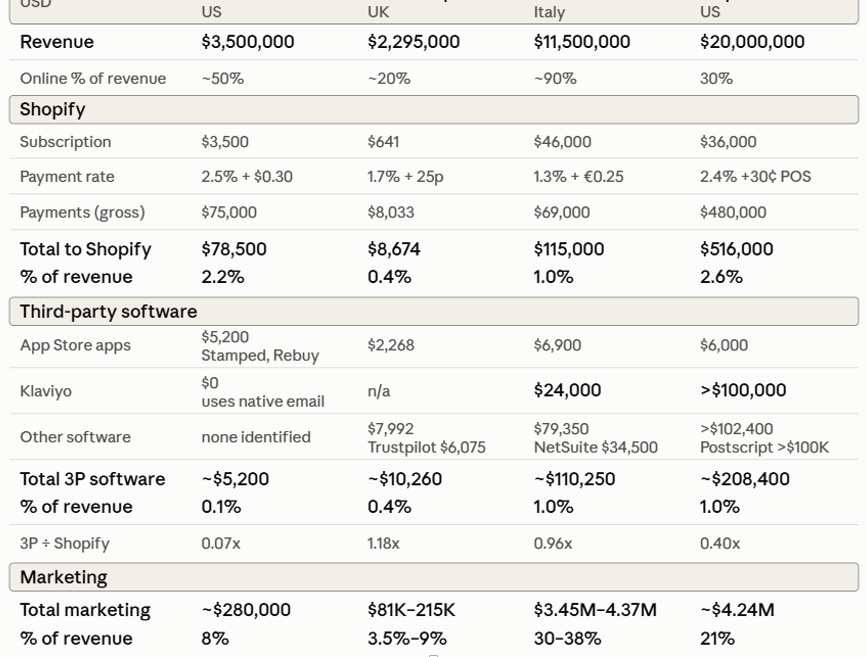
Each merchant said Shopify Plus great value and undermonetised:
If they raised the price on me 10x, I would not consider anything else. They would have to raise the price probably 100x for me to even start thinking about it. If they told me I would have to pay $100,000, I would probably still stay on Shopify… They have a lot of pricing power. There is no alternative. It is literally a monopoly. - Founder, $4M US Shopify Merchant
If we continue to grow to €15–20 million and Shopify costs even €100K but adds value — connecting ChatGPT, showing attribution models — I would be happy to spend that money. - Co-Founder, €10M Italian DTC Home Textiles Brand
The $3,000 flat fee for everything Shopify offers is a reasonable cost for us. - Founder, $20M US Omnichannel Retailer
A UK-based merchant with ~$3M in revenue pays more for Xero than for its Shopify subscription.
I think Xero is £60 a month now, which is painful because it was around £15 back in the day. It is one of those situations where you get locked in and they just keep raising the price - Current Shopify Merchant
Historically, Shopify Plus pricing has lagged CPI:
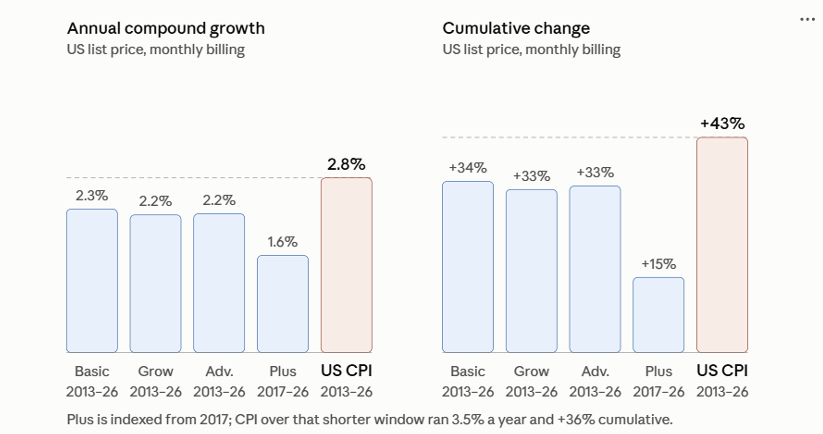
Shopify has been cautious about using pricing as a growth lever given Plus is the entry point to drive monetization across the Shopify ecosystem.
If we charge too much for that, then I think that impedes that. So, as we think of the success of our business long term, it's all the growth initiatives we've talked about in terms of enterprise, Point of Sale, our Core subscription, et cetera. It's not price increases. - Jeff Hoffmeister, CFO, Shopify (2024)
The interviews go on to explore how merchants perceive Shopify's value-add, switching costs, and how Shopify can win wallet share from Klaviyo:
Related Content

© 2026 In Practise. All rights reserved. This material is for informational purposes only and should not be considered as investment advice.